

05 Jan 2026
| 05 Jan 2026
Towards fully coupled Thermo-Hydro-Mechanical-Chemical (THMC) modelling in advanced reservoir engineering: GOLEM-PHREEQC

GFZ German Research Centre for Geosciences, Telegrafenberg, Potsdam, 14473, Germany
Samuele Frigo
GFZ German Research Centre for Geosciences, Telegrafenberg, Potsdam, 14473, Germany
Department of Engineering Geology, Institute of Applied Geosciences, Technical University of Berlin, Ernst-Reuter-Platz 1, Berlin, 10587, Germany
Max Lübke
Institute of Computer Science, University of Potsdam, An der Bahn 2, Potsdam, 14476, Germany
Mauro Cacace
GFZ German Research Centre for Geosciences, Telegrafenberg, Potsdam, 14473, Germany
Department of Engineering Geology, Institute of Applied Geosciences, Technical University of Berlin, Ernst-Reuter-Platz 1, Berlin, 10587, Germany
Elena Petrova
GFZ German Research Centre for Geosciences, Telegrafenberg, Potsdam, 14473, Germany
Hannes Hofmann
GFZ German Research Centre for Geosciences, Telegrafenberg, Potsdam, 14473, Germany
Department of Engineering Geology, Institute of Applied Geosciences, Technical University of Berlin, Ernst-Reuter-Platz 1, Berlin, 10587, Germany
Magdalena Scheck-Wenderoth
GFZ German Research Centre for Geosciences, Telegrafenberg, Potsdam, 14473, Germany
Department of Engineering Geology, Institute of Applied Geosciences, Technical University of Berlin, Ernst-Reuter-Platz 1, Berlin, 10587, Germany
Guido Blöcher
GFZ German Research Centre for Geosciences, Telegrafenberg, Potsdam, 14473, Germany
Department of Engineering Geology, Institute of Applied Geosciences, Technical University of Berlin, Ernst-Reuter-Platz 1, Berlin, 10587, Germany
Related authors

Marco De Lucia, Marco Fabbri, and Theresa Hennig
Adv. Geosci., 67, 35–44, https://doi.org/10.5194/adgeo-67-35-2025, https://doi.org/10.5194/adgeo-67-35-2025, 2025
Short summary
Short summary
The effect of spatial variability on uranium diffusion in Opalinus Clay over a million years was assessed by 2D reactive transport simulations. Different rock types and porosity impacted results, with variability's influence growing with longer correlation lengths of geostatistical simulations (up to 12.9 %). This highlights that 1D models may underestimate uncertainty in long-term radionuclide transport at repository sites, and spatial variability must be considered.
Marco De Lucia
Adv. Geosci., 65, 45–54, https://doi.org/10.5194/adgeo-65-45-2024, https://doi.org/10.5194/adgeo-65-45-2024, 2024
Short summary
Short summary
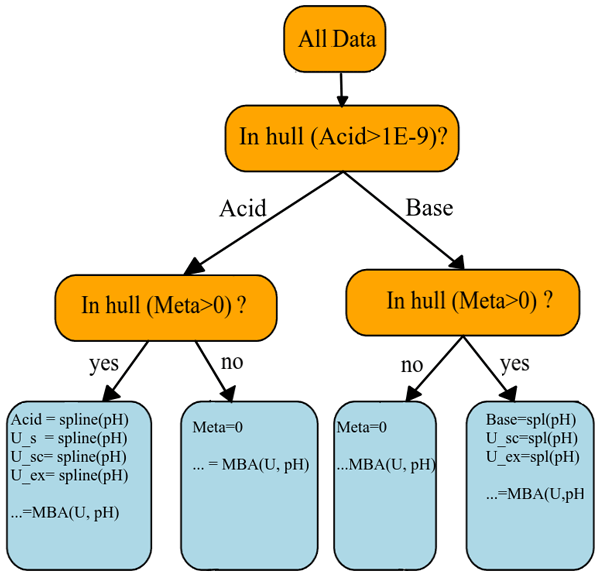
This paper presents a surrogate modelling approach applied to a geochemical system of uranium sorption on clay, relevant for the safety assessment of nuclear waste repositories. The surrogate uses knowledge about the underlying process to recursively partition the dataset into regions of reduced dimensionality. It achieves high accuracy with a competitive prediction throughput, and is a promising method to speedup computationally demanding coupled reactive transport models.
Marco De Lucia, Michael Kühn, Alexander Lindemann, Max Lübke, and Bettina Schnor
Geosci. Model Dev., 14, 7391–7409, https://doi.org/10.5194/gmd-14-7391-2021, https://doi.org/10.5194/gmd-14-7391-2021, 2021
Short summary
Short summary
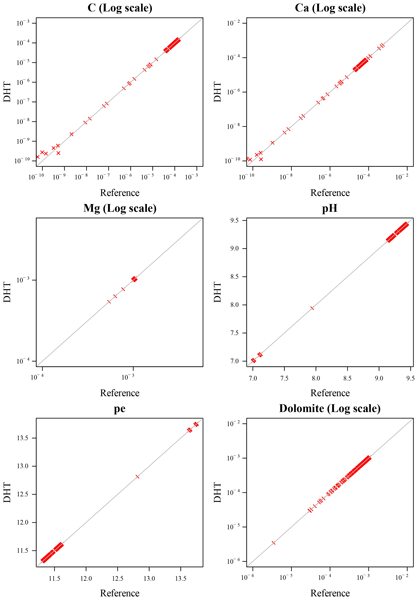
POET is a parallel reactive transport simulator which implements a mechanism to store and reuse previous results of geochemical simulations through distributed hash tables. POET parallelizes chemistry using a master/worker design with noncontiguous grid partitions to maximize its efficiency and load balance on shared-memory machines and compute clusters.
Mohammad Sabah, Mauro Cacace, Inga Berre, Iman R. Kivi, and Hannes Hofmann
EGUsphere, https://doi.org/10.5194/egusphere-2026-1658, https://doi.org/10.5194/egusphere-2026-1658, 2026
Short summary
Short summary
We developed a new way to simulate earthquakes triggered by fluid injection deep underground. These events involve both slow pressure build-up and rapid fault movement, which are difficult to capture together. Our method combines two calculation approaches and switches between them when needed. It reproduces earthquake behavior accurately while reducing computing time by up to seventy percent, making it more practical for assessing risks in energy and storage projects.
Mikhail Tsypin, Viet Dung Nguyen, Mauro Cacace, Guido Blöcher, Magdalena Scheck-Wenderoth, Elco Luijendijk, and Charlotte Krawczyk
Hydrol. Earth Syst. Sci., 30, 1647–1673, https://doi.org/10.5194/hess-30-1647-2026, https://doi.org/10.5194/hess-30-1647-2026, 2026
Short summary
Short summary
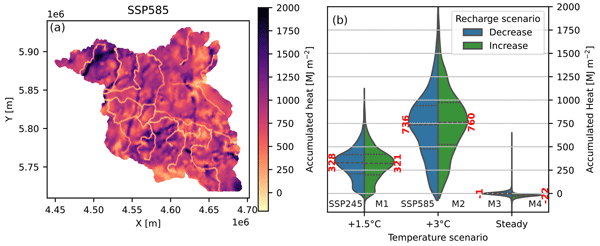
Shallow groundwater temperatures are increasing as a consequence of global warming. At the same time, climate scenarios project substantial changes in future groundwater recharge, with impacts on groundwater dynamics. We modeled the combined effects of these two processes. Our results suggest that reduce annual recharge or a higher share of cold winter recharge can locally slow groundwater warming, but not sufficiently to stop or reverse the overall warming trend.
Cornelius O. Schwarze, Liang Pei, Lioba Virchow, Elena Petrova, Ben Norden, Simona Regenspurg, Katrin Kieling, Guido Blöcher, and Stefan Kranz
Adv. Geosci., 67, 69–78, https://doi.org/10.5194/adgeo-67-69-2025, https://doi.org/10.5194/adgeo-67-69-2025, 2025
Short summary
Short summary
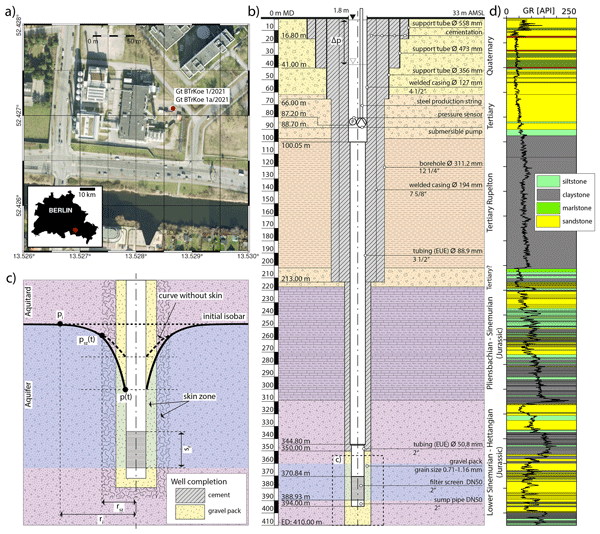
To make better use of underground heat storage, we need to understand how water flows through deep rock layers. Normally, this is tested after drilling is finished, but we tried doing it during an earlier stage to save time and effort. At a site in Berlin, we tested a new way to measure how water moves through rock while the borehole was still being developed. The method worked well and gives quicker, reliable insights into underground conditions.
Marco De Lucia, Marco Fabbri, and Theresa Hennig
Adv. Geosci., 67, 35–44, https://doi.org/10.5194/adgeo-67-35-2025, https://doi.org/10.5194/adgeo-67-35-2025, 2025
Short summary
Short summary
The effect of spatial variability on uranium diffusion in Opalinus Clay over a million years was assessed by 2D reactive transport simulations. Different rock types and porosity impacted results, with variability's influence growing with longer correlation lengths of geostatistical simulations (up to 12.9 %). This highlights that 1D models may underestimate uncertainty in long-term radionuclide transport at repository sites, and spatial variability must be considered.
Javier Abreu-Torres, Gergő Hutka, Guido Blöcher, Mauro Cacace, Vincent Magnenet, and Jean Schmittbuhl
Adv. Geosci., 65, 117–125, https://doi.org/10.5194/adgeo-65-117-2025, https://doi.org/10.5194/adgeo-65-117-2025, 2025
Short summary
Short summary
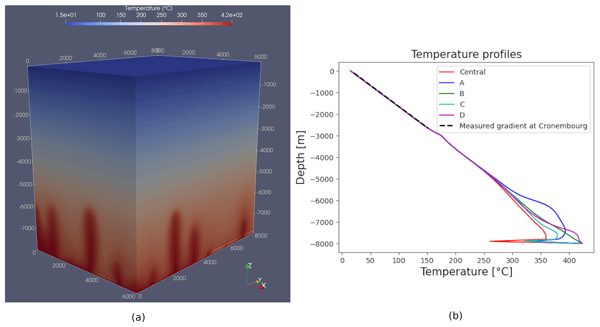
We develop a simplified model which describes the geological geometry of the Vendenheim site, the solid and fluid properties were adapted from studies in the area. We implement compute the hydrothermal flow with a temperature dependent density and viscosity in a porous medium, in order to verify if a hydrothermal convective system is compatible with known observations at the Vendenheim site, and to get a better idea of the initial conditions of a model for an induced seismicity model.
Kalliopi Tzoufka, Guido Blöcher, Mauro Cacace, Daniela Pfrang, and Kai Zosseder
Adv. Geosci., 65, 103–111, https://doi.org/10.5194/adgeo-65-103-2024, https://doi.org/10.5194/adgeo-65-103-2024, 2024
Short summary
Short summary
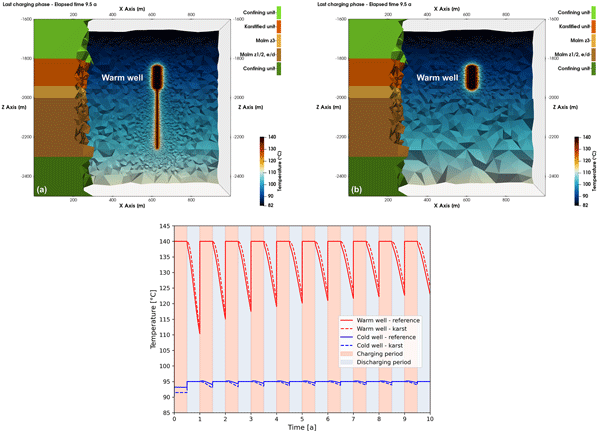
Concepts of High-Temperature Aquifer Thermal Energy Storage (HT-ATES) are investigated for system application in the German Molasse Basin. We quantify via physics-based numerical modelling the system performance with respect to HT-ATES concept development and provide a predictive analysis of HT-ATES application in the Upper Jurassic reservoir. Results demonstrate a non-uniform layer-specific distribution of the thermal front propagation, while promising heat recovery efficiencies are predicted.
Marco De Lucia
Adv. Geosci., 65, 45–54, https://doi.org/10.5194/adgeo-65-45-2024, https://doi.org/10.5194/adgeo-65-45-2024, 2024
Short summary
Short summary
This paper presents a surrogate modelling approach applied to a geochemical system of uranium sorption on clay, relevant for the safety assessment of nuclear waste repositories. The surrogate uses knowledge about the underlying process to recursively partition the dataset into regions of reduced dimensionality. It achieves high accuracy with a competitive prediction throughput, and is a promising method to speedup computationally demanding coupled reactive transport models.
Liang Pei, Lioba Virchow, Guido Blöcher, Stefan Kranz, and Ali Saadat
Adv. Geosci., 65, 37–44, https://doi.org/10.5194/adgeo-65-37-2024, https://doi.org/10.5194/adgeo-65-37-2024, 2024
Short summary
Short summary
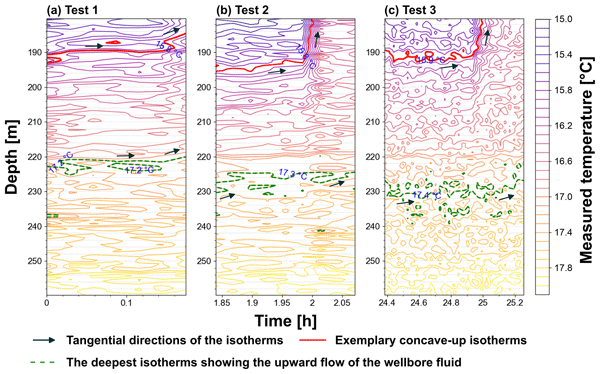
To operate aquifer thermal energy storages in a sustainable way, we located an artesian aquifer other than the aquifer storage in a research wellbore by analyzing the subsurface temperature as monitored with a fiber optic cable in three artesian flow tests. The positioning of the artesian aquifer was validated via numerical modelling. Analyses of the temperature data and numerical modelling enabled determining the profile of flow velocity, flow rate and the depth interval of inflow.
Ángela María Gómez-García, Álvaro González, Mauro Cacace, Magdalena Scheck-Wenderoth, and Gaspar Monsalve
Solid Earth, 15, 281–303, https://doi.org/10.5194/se-15-281-2024, https://doi.org/10.5194/se-15-281-2024, 2024
Short summary
Short summary
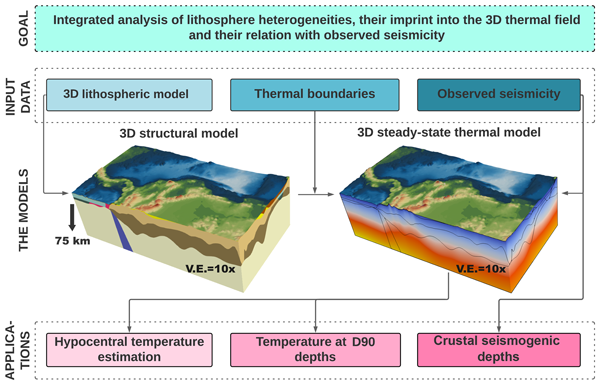
We compute a realistic three-dimensional model of the temperatures down to 75 km deep within the Earth, below the Caribbean Sea and northwestern South America. Using this, we estimate at which rock temperatures past earthquakes nucleated in the region and find that they agree with those derived from laboratory experiments of rock friction. We also analyse how the thermal state of the system affects the spatial distribution of seismicity in this region.
Marco De Lucia, Michael Kühn, Alexander Lindemann, Max Lübke, and Bettina Schnor
Geosci. Model Dev., 14, 7391–7409, https://doi.org/10.5194/gmd-14-7391-2021, https://doi.org/10.5194/gmd-14-7391-2021, 2021
Short summary
Short summary
POET is a parallel reactive transport simulator which implements a mechanism to store and reuse previous results of geochemical simulations through distributed hash tables. POET parallelizes chemistry using a master/worker design with noncontiguous grid partitions to maximize its efficiency and load balance on shared-memory machines and compute clusters.
Steffen Ahlers, Andreas Henk, Tobias Hergert, Karsten Reiter, Birgit Müller, Luisa Röckel, Oliver Heidbach, Sophia Morawietz, Magdalena Scheck-Wenderoth, and Denis Anikiev
Saf. Nucl. Waste Disposal, 1, 163–164, https://doi.org/10.5194/sand-1-163-2021, https://doi.org/10.5194/sand-1-163-2021, 2021
Cited articles
André, L., Rabemanana, V., and Vuataz, F.: Influence of water-rock interactions on fracture permeability of the deep reservoir at Soultz-sous-Forêts, France, Geothermics, 35, 507–531, https://doi.org/10.1016/j.geothermics.2006.09.006, 2006. a
Balay, S., Abhyankhar, S., Adams, M., Brown, J., Brune, P., Buschelman, K., Dalcin, L., Eijkhout, V., Gropp, W., Kaushik, D., Knepley, M., Curfman McInnes, L., Rupp, K., Smith, B., Zampini, S., and Zhang, H.: PETSc Users Manual, Tech. rep., Argonne National Laboratory, https://doi.org/10.2172/1577437, 2016. a, b
Bea, S., Carrera, J., Ayora, C., Batlle, F., and Saaltink, M.: CHEPROO: A Fortran 90 object-oriented module to solve chemical processes in Earth Science models, Computers & Geosciences, 35, 1098–1112, https://doi.org/10.1016/j.cageo.2008.08.010, 2009. a
Blöcher, G., Regenspurg, S., Kranz, S., Lipus, M., Pei, L., Norden, B., Reinsch, T., Henninges, J., Siemon, R., Orenczuk, D., Zeilfelder, S., Scheytt, T., and Saadat, A.: Best practices for characterization of High Temperature-Aquifer Thermal Energy Storage (HT-ATES) potential using well tests in Berlin (Germany) as an example, Geothermics, 116, https://doi.org/10.1016/j.geothermics.2023.102830, 2024. a
Bundschuh, J. and Suárez Arriaga, M.: Introduction to the numerical modeling of groundwater and geothermal systems. Fundamentals of mass, energy, and solute transport in poroelastic rocks, Multiphisycs Modelling 2, CRC Press, Boca Raton, FL, ISBN 978-0-203-84810-4, https://doi.org/10.1201/b10499, 2010. a
Bächler, D. and Kohl, T.: Coupled thermal-hydraulic-chemical modelling of enhanced geothermal systems, Geophysical Journal International, 161, 533–548, https://doi.org/10.1111/j.1365-246X.2005.02497.x, 2005. a
Cacace, M. and Jacquey, A. B.: Flexible parallel implicit modelling of coupled thermal–hydraulic–mechanical processes in fractured rocks, Solid Earth, 8, 921–941, https://doi.org/10.5194/se-8-921-2017, 2017. a, b, c, d
Carman, P.: Fluid flow through granular beds, Transactions, Institution of Chemical Engineers, London, 15, 150–166, 1937. a
Carman, P.: Flow of gases through porous media, Butterworths, London, https://doi.org/10.1016/0010-2180(57)90038-X, 1956. a
Charlton, S. and Parkhurst, D.: Modules based on the geochemical model PHREEQC for use in scripting and programming languages, Computers & Geosciences, 37, 1653–1663, https://doi.org/10.1016/j.cageo.2011.02.005, 2011. a, b
Chow, E., Cleary, A., and Falgout, R.: Design of the hypre preconditioner library, in: Proc. of the SIAM Workshop on Object Oriented Methods for Inter-operable Scientific and Engineering Computing, edited by: Henderson, M., Anderson, C., and Lyons, S., SIAM Press, Yorktown Heights, New York, USA, https://www.osti.gov/biblio/8519 (last access: 22 December 2025), 1998. a
COMSOL AB: COMSOL Multiphysics® Reference Manual, version 6.3, COMSOL AB, Stockholm, Sweden, http://www.comsol.com (last access: 15 June 2025), 2024. a
De Lucia, M. and Kühn, M.: Geochemical and reactive transport modelling in R with the RedModRphree package, Adv. Geosci., 56, 33–43, https://doi.org/10.5194/adgeo-56-33-2021, 2021. a
De Lucia, M., Kühn, M., Lindemann, A., Lübke, M., and Schnor, B.: POET (v0.1): speedup of many-core parallel reactive transport simulations with fast DHT lookups, Geosci. Model Dev., 14, 7391–7409, https://doi.org/10.5194/gmd-14-7391-2021, 2021. a, b, c
Engesgaard, P. and Kipp, K.: A geochemical transport model for redox-controlled movement of mineral fronts in groundwater flow systems – a case of nitrate removal by oxidation of pyrite, Water Resources Research, 28, 2829–2843, https://doi.org/10.1029/92WR01264, 1992. a
Gaston, D., Newman, C., Hansen, G., and Lebrun-Grandié, D.: MOOSE: A parallel computational framework for coupled systems of nonlinear equations, Nuclear Engineering and Design, 239, 1768–1778, https://doi.org/10.1016/j.nucengdes.2009.05.021, 2009. a
Greenshields, C. and Weller, H.: Notes on Computational Fluid Dynamics: General Principles, CFD Direct Ltd, Reading, UK, ISBN 978-1-3999-2078-0, 2022. a
He, W., Beyer, C., Fleckenstein, J. H., Jang, E., Kolditz, O., Naumov, D., and Kalbacher, T.: A parallelization scheme to simulate reactive transport in the subsurface environment with OGS#IPhreeqc 5.5.7-3.1.2, Geosci. Model Dev., 8, 3333–3348, https://doi.org/10.5194/gmd-8-3333-2015, 2015. a, b
Heroux, M., Phipps, E., Salinger, A., Thornquist, H., Tuminaro, R., Willenbring, J., Williams, A., Stanley, K., Bartlett, R., Howle, V., Hoekstra, R., Hu, J., Kolda, T., Lehoucq, R., Long, K., and Pawlowski, R.: An overview of the Trilinos project, ACM T. Math. Software, 31, 397–423, https://doi.org/10.1145/1089014.1089021, 2005. a
Jing, Z., Watanabe, K., Willis-Richards, J., and Hashida, T.: A 3-D water/rock chemical interaction model for prediction of HDR/HWR geothermal reservoir performance, Geothermics, 31, 1–28, https://doi.org/10.1016/S0375-6505(00)00059-6, 2002. a
Kirk, B., Peterson, J., Stogner, R., and Carey, G.: libMesh: a C++ library for parallel adaptive mesh refinement/coarsening simulations, Eng. Comput., 22, 237–254, https://doi.org/10.1007/s00366-006-0049-3, 2006. a
Kiryukhin, A., Xu, T., Pruess, K., Apps, J., and Slovtsov, I.: Thermal-hydrodynamic-chemical (THC) modeling based on geothermal field data, Geothermics, 33, 349–381, https://doi.org/10.1016/j.geothermics.2003.09.005, 2004. a
Kozeny, J.: Ueber kapillare Leitung des Wassers im Boden, Sitzungsberichte Wiener Akademie, 136, 271–306, 1927. a
Kulik, D. A., Wagner, T., Dmytrieva, S. V., Kosakowski, G., Hingerl, F. F., Chudnenko, K. V., and Berner, U. R.: GEM-Selektor geochemical modeling package: revised algorithm and GEMS3K numerical kernel for coupled simulation codes, Computational Geosciences, https://doi.org/10.1007/s10596-012-9310-6, 2012. a
Kyas, S., Volpatto, D., Saar, M. O., and Leal, A. M. M.: Accelerated reactive transport simulations in heterogeneous porous media using Reaktoro and Firedrake, Computational Geosciences, 26, 295–327, https://doi.org/10.1007/s10596-021-10126-2, 2022. a
Leal, A. M. M., Kyas, S., Kulik, D. A., and Saar, M. O.: Accelerating Reactive Transport Modeling: On-Demand Machine Learning Algorithm for Chemical Equilibrium Calculations, Transport in Porous Media, https://doi.org/10.1007/s11242-020-01412-1, 2020. a, b
Logg, A., Mardal, K., and Wells, G.: Automated solution of differential equations by the finite element method: The FEniCS book, Springer-Verlag, Berlin Heidelberg, https://doi.org/10.1007/978-3-642-23099-8, 2012. a
Lübke, M., De Lucia, M., Petri, S., and Schnor, B.: A fast MPI-based Distributed Hash-Table as Surrogate Model demonstrated in a coupled reactive transport HPC simulation, in: Proceedings of the 25th International Conference on Computational Science, Singapore, https://doi.org/10.1007/978-3-031-97635-3_28, 2025. a
Marty, N. C., Claret, F., Lassin, A., Tremosa, J., Blanc, P., Madé, B., Giffaut, E., Cochepin, B., and Tournassat, C.: A database of dissolution and precipitation rates for clay-rocks minerals, Applied Geochemistry, 55, 108–118, https://doi.org/10.1016/j.apgeochem.2014.10.012, 2015. a
Mayer, K. U., Frind, E. O., and Blowes, D. W.: Multicomponent reactive transport modeling in variably saturated porous media using a generalized formulation for kinetically controlled reactions, Water Resources Research, 38, https://doi.org/10.1029/2001wr000862, 2002. a
Meeussen, J. C. L.: ORCHESTRA: An Object-Oriented Framework for Implementing Chemical Equilibrium Models, Environmental Science & Technology, 37, 1175–1182, https://doi.org/10.1021/es025597s, 2003. a
Mills, R., Lu, C., Lichtner, P., and Hammond, G.: Simulating subsurface flow and transport on ultrascale computers using PFLOTRAN, Journal of Physics: Conference Series, 78, https://doi.org/10.1088/1742-6596/78/1/012051, 2007. a
Molins, S., Andre, B. J., Johnson, J. N., Hammond, G. E., Sulman, B. N., Lipnikov, K., Day, M. S., Beisman, J. J., Svyatsky, D., Deng, H., Lichtner, P. C., Steefel, C. I., and Moulton, J. D.: Alquimia v1.0: a generic interface to biogeochemical codes – a tool for interoperable development, prototyping and benchmarking for multiphysics simulators, Geosci. Model Dev., 18, 3241–3263, https://doi.org/10.5194/gmd-18-3241-2025, 2025. a
Nardi, A., Idiart, A., Trinchero, P., de Vries, L., and Xu, T.: Interface COMSOL-PHREEQC (iCP), an efficient numerical framework for the solution of coupled multiphysics and geochemistry, Computers & Geosciences, 69, 10–21, https://doi.org/10.1016/j.cageo.2014.04.011, 2014. a
Palandri, J. and Kharaka, Y.: A compilation of rate parameters of water-mineral interaction kinetics for application to geochemical modeling, Tech. rep., USGS, Menlo Park, California, USA, https://doi.org/10.3133/ofr20041068, 2004. a
Pandey, S., Vishal, V., and Chaudhuri, A.: Geothermal reservoir modeling in a coupled thermo-hydro-mechanical-chemical approach: A review, Earth-Science Reviews, 185, 1157–1169, https://doi.org/10.1016/j.earscirev.2018.09.004, 2018. a
Parkhurst, D. and Appelo, C.: Description of Input and Examples for PHREEQC Version 3 – A Computer Program for Speciation, Batch-Reaction, One-Dimensional Transport, and Inverse Geochemical Calculations, Tech. Rep. 6-A43, U.S. Geological Survey, Reston, VA, https://doi.org/10.3133/tm6A43, 2013. a, b, c
Parkhurst, D. and Wissmeier, L.: PhreeqcRM: A reaction module for transport simulators based on the geochemical model PHREEQC, Adv. Water Resour., 83, 176–189, https://doi.org/10.1016/j.advwatres.2015.06.001, 2015. a
Parkhurst, D., Kipp, K., and Charlton, S.: PHAST Version 2-A Program for Simulating Groundwater Flow, Solute Transport, and Multicomponent Geochemical Reactions, Tech. Rep. 6-A35, U.S. Geological Survey, https://doi.org/10.3133/tm6A35, 2010. a
Permann, C., Gaston, D., Andrš, D., Carlsen, R., Kong, F., Lindsay, A., Miller, J., Peterson, J., Slaughter, A., Stogner, R., and Martineau, R.: MOOSE: Enabling massively parallel multiphysics simulation, SoftwareX, 11, https://doi.org/10.1016/j.softx.2020.100430, 2020. a, b
Prommer, H., Davis, G., and Barry, D.: PHT3D-a three-dimensional biogeochemical transport model for modelling natural and enhanced remediation, in: Proceedings of the Contaminated Site Remediation: Challenges Posed by Urban and Industrial Contaminants, Fremantle, Western Australia, 21–25, 1999. a
Rabemanana, V., Durst, P., Bächler, D., Vuataz, F., and Kohl, T.: Geochemical modelling of the Soultz-sous-Forêts Hot Fractured Rock system: comparison of two reservoirs at 3.8 and 5 km depth, Geothermics, 32, 645–653, https://doi.org/10.1016/S0375-6505(03)00069-5, 2003. a
Regenspurg, S., Alawi, M., Norden, B., Vieth-Hillebrand, A., Blöcher, G., Kranz, S., Scheytt, T., Horn, F., Burckhardt, O., Rach, O., and Saadat, A.: Effect of cold and hot water injection on the chemical and microbial composition of an aquifer and implication for its use as an aquifer thermal energy storage, Geothermics, 84, https://doi.org/10.1016/j.geothermics.2019.101747, 2020. a
Saaltink, M., Batlle, F., Carrera, J., and Olivella, S.: RETRASO, a code for modeling reactive transport in saturated and unsaturated porous media, Geologica Acta, 2, 235–251, 2004. a
Samper, J., Yang, C., and Montenegro, L.: CORE2D version 4: A Code for Non-Isothermal Water Flow and Reactive Solute Transport, User's Manual, Tech. rep., University of La Coruña, Spain, https://inis.iaea.org/records/vgeyd-xc106 (last access: 22 December 2025), 2003. a
Soulaine, C., Pavuluri, S., Claret, F., and Tournassat, C.: porousMedia4Foam: Multi-scale open-source platform for hydro-geochemical simulations with OpenFOAM, Environmental Modelling & Software, 145, 105199, https://doi.org/10.1016/j.envsoft.2021.105199, 2021. a
Steefel, C.: CrunchFlow: Software for Modeling Multicomponent Reactive Flow and Transport, Tech. rep., Earth Sciences Division, Lawrence Berkeley National Laboratory, Berkeley, CA, https://www.netl.doe.gov/sites/default/files/netl-file/CrunchFlow-Manual.pdf (last access: 22 December 2025), 2009. a
Steefel, C. I., Appelo, C. A. J., Arora, B., Jacques, D., Kalbacher, T., Kolditz, O., Lagneau, V., Lichtner, P. C., Mayer, K. U., Meeussen, J. C. L., Molins, S., Moulton, D., Shao, H., Šimůnek, J., Spycher, N., Yabusaki, S. B., and Yeh, G. T.: Reactive transport codes for subsurface environmental simulation, Computational Geosciences, 19, 445–478, https://doi.org/10.1007/s10596-014-9443-x, 2014. a
Thoenen, T., Hummel, W., Berner, U., and Curti, E.: The PSI/Nagra Chemical Thermodynamic Data Base 12/07, Tech. Rep. PSI Report 14-04, Paul Scherrer Institute, Villigen, Switzerland, ISSN 1019-0643, 2014. a
Trebotich, D., Van Straalen, B., Graves, D., and Colella, P.: Performance of embedded boundary methods for CFD with complex geometry, Journal of Physics: Conference Series, 125, https://doi.org/10.1088/1742-6596/125/1/012083, 2008. a
Van der Lee, J., de Windt, L., Lagneau, V., and Goblet, P.: Module-oriented modeling of reactive transport with HYTEC, Computers & Geosciences, 29, 265–275, https://doi.org/10.1016/S0098-3004(03)00004-9, 2003. a
Wilkins, A., Green, C., Harbour, L., and Podgorney, R.: The MOOSE geochemistry module, Journal of Open Source Software, 6, 3314, https://doi.org/10.21105/joss.03314, 2021. a
Xu, T., Spycher, N., Sonnenthal, E., Zhang, G., Zheng, L., and Pruess, K.: TOUGHREACT Version 2.0: A simulator for subsurface reactive transport under non-isothermal multiphase flow conditions, Computers & Geosciences, 37, 763–774, https://doi.org/10.1016/j.cageo.2010.10.007, 2011. a
Šimůnek, J., Jacques, D., van Genuchten, M., and Mallants, D.: Multicomponent geochemical transport modeling using HYDRUS-1D and HP1, Journal of the American Water Resources Association, 42, 1537–1547, https://doi.org/10.1111/j.1752-1688.2006.tb06019.x, 2006. a
Short summary
We introduce a novel coupling of GOLEM, a thermal-hydraulic-mechanical simulator, with the PHREEQC geochemical solver. The code is validated via benchmarks against reference 1D models and its functionalities demonstrated on a 2D geochemical heterogeneous domain. This open-source software enables the simulation of complex subsurface processes for the development of geothermal resources.
We introduce a novel coupling of GOLEM, a thermal-hydraulic-mechanical simulator, with the...


