
Characterization of the hydraulic properties of a planned High Temperature Aquifer Thermal Energy Storage (HT-ATES) system during well development
Cornelius O. Schwarze
CORRESPONDING AUTHOR
GFZ Helmholtz Centre for Geosciences, 14473 Potsdam, Germany
Liang Pei
GFZ Helmholtz Centre for Geosciences, 14473 Potsdam, Germany
Lioba Virchow
GFZ Helmholtz Centre for Geosciences, 14473 Potsdam, Germany
Elena Petrova
GFZ Helmholtz Centre for Geosciences, 14473 Potsdam, Germany
Ben Norden
GFZ Helmholtz Centre for Geosciences, 14473 Potsdam, Germany
Simona Regenspurg
GFZ Helmholtz Centre for Geosciences, 14473 Potsdam, Germany
Katrin Kieling
GFZ Helmholtz Centre for Geosciences, 14473 Potsdam, Germany
Guido Blöcher
GFZ Helmholtz Centre for Geosciences, 14473 Potsdam, Germany
Technical University Berlin, Department of Engineering Geology, 10623 Berlin, Germany
Stefan Kranz
GFZ Helmholtz Centre for Geosciences, 14473 Potsdam, Germany
Related authors
No articles found.
Mikhail Tsypin, Viet Dung Nguyen, Mauro Cacace, Guido Blöcher, Magdalena Scheck-Wenderoth, Elco Luijendijk, and Charlotte Krawczyk
EGUsphere, https://doi.org/10.5194/egusphere-2025-4335, https://doi.org/10.5194/egusphere-2025-4335, 2025
Short summary
Short summary
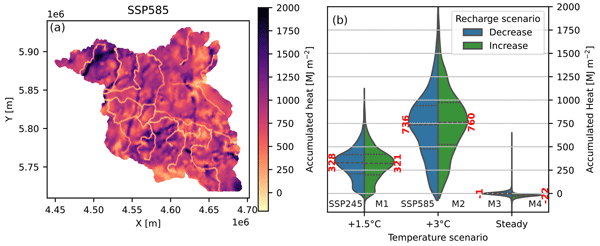
Shallow groundwater temperatures are increasing as a consequence of global warming. At the same time, climate models project substantial changes in future groundwater recharge, with impacts on groundwater levels. We investigated the combined effects of these two processes. Our modeling results suggest that decreased annual recharge or increased cold recharge in winter can locally slow groundwater warming, but not sufficiently to stop or reverse the overall warming trend.
Florian Neumann, Ben Norden, Elif Balkan-Pazvantoğlu, Samah Elbarbary, Alexey G. Petrunin, Kirsten Elger, Samuel Jennings, Simone Frenzel, and Sven Fuchs
Earth Syst. Sci. Data Discuss., https://doi.org/10.5194/essd-2025-341, https://doi.org/10.5194/essd-2025-341, 2025
Preprint under review for ESSD
Short summary
Short summary
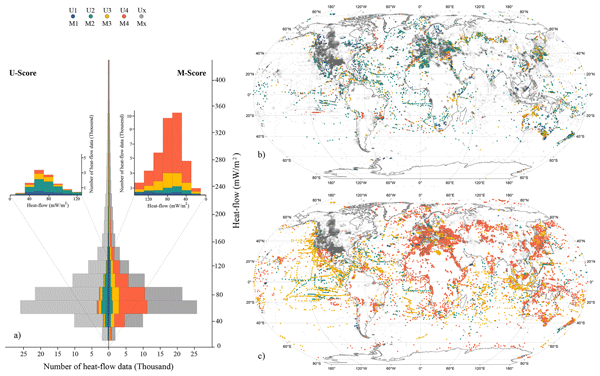
The Global Heat Flow Database grew from 58,302 data points in 2012 to 91,182 in 2024, with enhanced quality assessments. Despite this, gaps in data and methodological details persist, especially in underrepresented regions. The database is crucial for geophysical, geothermal, and environmental research, offering valuable insights into Earth's thermal processes.
Javier Abreu-Torres, Gergő Hutka, Guido Blöcher, Mauro Cacace, Vincent Magnenet, and Jean Schmittbuhl
Adv. Geosci., 65, 117–125, https://doi.org/10.5194/adgeo-65-117-2025, https://doi.org/10.5194/adgeo-65-117-2025, 2025
Short summary
Short summary
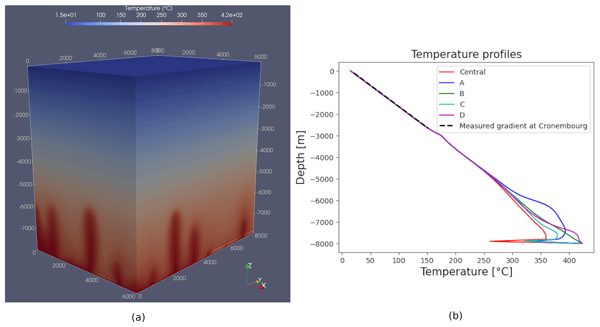
We develop a simplified model which describes the geological geometry of the Vendenheim site, the solid and fluid properties were adapted from studies in the area. We implement compute the hydrothermal flow with a temperature dependent density and viscosity in a porous medium, in order to verify if a hydrothermal convective system is compatible with known observations at the Vendenheim site, and to get a better idea of the initial conditions of a model for an induced seismicity model.
Kalliopi Tzoufka, Guido Blöcher, Mauro Cacace, Daniela Pfrang, and Kai Zosseder
Adv. Geosci., 65, 103–111, https://doi.org/10.5194/adgeo-65-103-2024, https://doi.org/10.5194/adgeo-65-103-2024, 2024
Short summary
Short summary
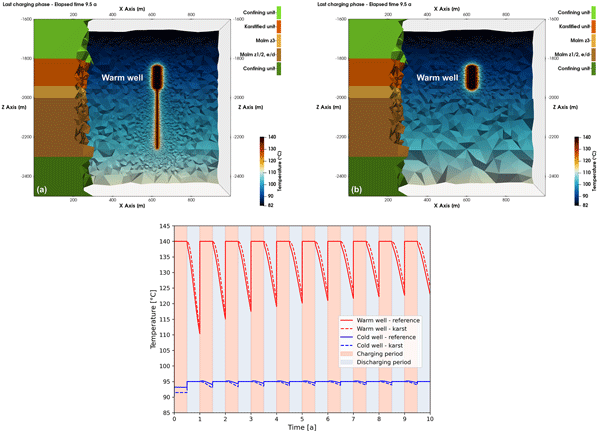
Concepts of High-Temperature Aquifer Thermal Energy Storage (HT-ATES) are investigated for system application in the German Molasse Basin. We quantify via physics-based numerical modelling the system performance with respect to HT-ATES concept development and provide a predictive analysis of HT-ATES application in the Upper Jurassic reservoir. Results demonstrate a non-uniform layer-specific distribution of the thermal front propagation, while promising heat recovery efficiencies are predicted.
Liang Pei, Lioba Virchow, Guido Blöcher, Stefan Kranz, and Ali Saadat
Adv. Geosci., 65, 37–44, https://doi.org/10.5194/adgeo-65-37-2024, https://doi.org/10.5194/adgeo-65-37-2024, 2024
Short summary
Short summary
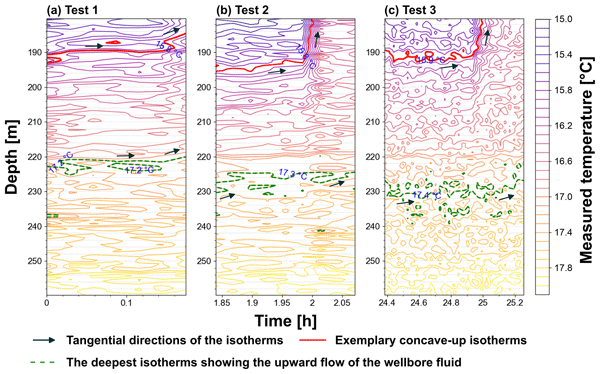
To operate aquifer thermal energy storages in a sustainable way, we located an artesian aquifer other than the aquifer storage in a research wellbore by analyzing the subsurface temperature as monitored with a fiber optic cable in three artesian flow tests. The positioning of the artesian aquifer was validated via numerical modelling. Analyses of the temperature data and numerical modelling enabled determining the profile of flow velocity, flow rate and the depth interval of inflow.
Cited articles
Bauer, D., Marx, R., Nußbicker-Lux, J., Ochs, F., Heidemann, W., and Müller-Steinhagen, H.: German central solar heating plants with seasonal heat storage, Solar Energy, 84, 612–623, https://doi.org/10.1016/j.solener.2009.05.013, 2010.
Bierschenk, W. H.: Determining Well Efficiency by Multiple Step-drawdown Tests, International Association of Scientific Hydrology, 64, 493–507, 1963.
Birsoy, Y. K. and Summers, W. K.: Determination of Aquifer Parameters from Step Tests and Intermittent Pumping Data, Groundwater, 18, 137–146, https://doi.org/10.1111/j.1745-6584.1980.tb03382.x, 1980.
Blöcher, G., Reinsch, T., Henninges, J., Milsch, H., Regenspurg, S., Kummerow, J., Francke, H., Kranz, S., Saadat, A., Zimmermann, G., and Huenges, E.: Hydraulic history and current state of the deep geothermal reservoir Groß Schönebeck. Geothermics, 63, 27–43, https://doi.org/10.1016/j.geothermics.2015.07.008, 2016.
Blöcher, G., Regenspurg, S., Kranz, S., Lipus, M., Pei, L., Norden, B., Reinsch, T., Henninges, J., Siemon, R., Orenczuk, D., Zeilfelder, S., Scheytt, T., and Saadat, A.: Best practices for characterization of High Temperature-Aquifer Thermal Energy Storage (HT-ATES) potential using well tests in Berlin (Germany) as an example, Geothermics, 116, 102830, https://doi.org/10.1016/j.geothermics.2023.102830, 2024.
Clark, L.: The analysis and planning of step drawdown tests, Quarterly Journal of Engineering Geology, 10, 125–143, https://doi.org/10.1144/GSL.QJEG.1977.010.02.03, 1977.
Cooper, H. H. and Jacob, C. E. J.: A generalized graphical method for evaluating formation constants and summarizing well-field history, Eos, Transactions American Geophysical Union, 27, 526–534, https://doi.org/10.1029/TR027i004p00526, 1946.
Dinçer, İ. and Rosen, M. A.: Thermal Energy Storage: Systems and Applications, 3rd edn., Wiley, Hoboken (NJ), ISBN 978-1-119-71315-9, 2010.
Eseimokumoh, I., Ereyananyo, O. W., and Eniye, O.: Reservoir and Wellbore Damage Estimation Using Pressure Transient Analysis (PTA), International Journal of Innovative Science and Research Technology, 6, 563–575, ISSN 2456-2165, 2021.
Fleuchaus, P., Godschalk, B., Stober, I., and Blum, P.: Worldwide application of aquifer thermal energy storage – A review, Renewable and Sustainable Energy Reviews, 94, 861–876, https://doi.org/10.1016/j.rser.2018.06.057, 2018.
Guo, B., Sun, K., and Ghalambor, A: Well Productivity Handbook, Gulf Publishing Company, ISBN 1933762322, 2008.
Guo, B., Liu, X., and Tan, X.: Petroleum Production Engineering Book, 2nd edn., s.l., Elsevier, https://doi.org/10.1016/B978-0-12-809374-0.00023-4, 2017.
Halford, K. J., Weight, W. D., and Schreiber, R. P.: Interpretation of Transmissivity Estimates from Single-Well Pumping Aquifer Tests, Groundwater, 44, 467–471, https://doi.org/10.1111/j.1745-6584.2005.00151.x, 2005.
Holub, J., Pech, P., Kuraz, M., Máca, P., and Kahuda, D.: Evaluation of a pumping test with skin effect and wellbore storage on a confined aquifer in the Bela Crkva, Serbia, International Journal of Water, 13, 1, https://doi.org/10.1504/IJW.2019.097309, 2019.
Horner, D. R.: Pressure Build-Up in Wells, Proceedings of the 3rd World Petroleum Congress, The Hague, the Netherlands, 25–43, 1951.
Hoth, K., Rusbült, J., Zagora, K., Beer, H., and Hartmann, O.: Die tiefen Bohrungen im Zentralabschnitt der Mitteleuropäischen Senke: Dokumentation für den Zeitabschnitt 1962–1990; mit zwei Tabellen, Schriftenreihe für Geowissenschaften, Verlag der Gesellschaft für Geowissenschaften, Verlag der Gesellschaft für Geowissenschaften, 145, ISSN 0947-4269, 1993.
Hoth, P.: Geowissenschaftliche Bewertungsgrundlagen zur Nutzung hydrogeothermaler Ressourcen in Norddeutschland, Scientific Technical Report/Geoforschungszentrum Potsdam, https://doi.org/10.23689/fidgeo-482, 1997.
Jacob, C. E.: Drawdown Test to Determine Effective Radius of Artesian Well, Transactions of the American Society of Civil Engineers, 112, 1047–1064, https://doi.org/10.1061/TACEAT.0006033, 1947.
Kærgaard, H.: The Step-Drawdown Test and Non-Darcian Flow: A Critical Review of Theory, Methods and Practice, Hydrology Research, 13, 247–256, https://doi.org/10.2166/nh.1982.0020, 1982
Kahuda, D. and Pech, P.: A New Method for the Evaluation of Well Rehabilitation from the Early Portion of a Pumping Test, Water, 12, 744, https://doi.org/10.3390/w12030744, 2020.
Langguth, H.-R. and Voigt, R.: Hydrogeologische Methoden, Springer Berlin Heidelberg, https://doi.org/10.1007/978-3-642-18655-4, 2004.
Lee, J.: Well testing, Soc. of Petroleum Engineers, Richardson, Tex., ISBN 0895203170, 1982.
Maliva, R. G.: Aquifer Pumping Tests, in: Aquifer Characterization Techniques, Springer International Publishing, Cham, 171–211, https://doi.org/10.1007/978-3-319-32137-0, 2016.
Muskat, M.: The Flow of Compressible Fluids Through Porous Media and Some Problems in Heat Conduction, Physics, 5, 71–94, https://doi.org/10.1063/1.1745233, 1934.
Norden, B., Virchow, L., Fuchs, S., Mitzscherling, J., Alibrandi, A., Gravendyck, J., Zimmer, M., and Saadat, A.: Section Geomorphology, Sediment Lab (2023): The explorational drilling Gt BTrKoe 1/2021 in Berlin Adlershof, Germany – Field Data and Measurements, V.1. GFZ Data Services, https://doi.org/10.5880/GFZ.4.8.2023.006, 2023.
Ramey, H. J.: Well-Loss Function and the Skin Effect: A Review, Recent Trends in Hydrogeology, 265–272, https://doi.org/10.1130/SPE189-P265, 1982.
Reynolds, O.: An experimental investigation of the circumstances which determine whether the motion of water shall be direct or sinuous, and of the law of resistance in parallel channels, Philosophical Transactions of the Royal Society of London, 174, 935–982, https://doi.org/10.1098/rstl.1883.0029, 1883.
Rorabaugh, M. J.: Graphical and Theoretical Analysis of Step Drawdown Test of Artesian Well, Proceedings of the American Society of Civil Engineers, 79, 1–23, 1953.
Van Poolen, H. K.: Radius-of-drainage and stabilization-time equations, The Oil and Gas Journal, 62, 138–146, 1964.
Short summary
To make better use of underground heat storage, we need to understand how water flows through deep rock layers. Normally, this is tested after drilling is finished, but we tried doing it during an earlier stage to save time and effort. At a site in Berlin, we tested a new way to measure how water moves through rock while the borehole was still being developed. The method worked well and gives quicker, reliable insights into underground conditions.
To make better use of underground heat storage, we need to understand how water flows through...