

12 Feb 2026
| 12 Feb 2026
Pore water or groundwater chemistry: what governs uranium migration in Opalinus Clay?
Tim Schöne
CORRESPONDING AUTHOR
GFZ Helmholtz Centre for Geosciences, Reactive Fluids and Geomaterials, Telegrafenberg, 14473 Potsdam, Germany
University of Potsdam, Institute of Geosciences, Karl-Liebknecht-Str. 24–25, 14476 Potsdam-Golm, Germany
Theresa Hennig
GFZ Helmholtz Centre for Geosciences, Reactive Fluids and Geomaterials, Telegrafenberg, 14473 Potsdam, Germany
Lawrence Berkeley National Laboratory, Energy Geosciences Division, Cyclotron Road 1, Berkeley, CA 94720, United States of America
Related authors
Michael Kühn, Graham Paul D. Viskovic, Tim Schöne, Melissa Präg, Charlotte Ribacki, Leonard Grabow, and Thomas Kempka
Adv. Geosci., 67, 91–100, https://doi.org/10.5194/adgeo-67-91-2025, https://doi.org/10.5194/adgeo-67-91-2025, 2025
Short summary
Short summary
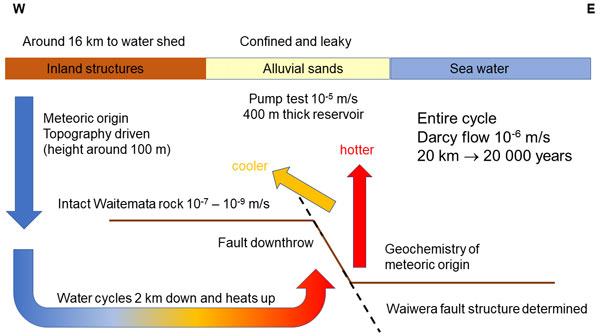
Waiwera in New Zealand is a small coastal village with a geothermal reservoir underneath. Hydrogeological models support water management by providing insights into sustainable extraction from the system. It is artesian and the geothermal water is of meteoric origin percolating down to sufficient depth getting heated. It rises through a fault zone into the shallow and leaky aquifer. Most recently the springs have restarted discharging geothermal water on the beach.
Michael Kühn, Graham Paul D. Viskovic, Tim Schöne, Melissa Präg, Charlotte Ribacki, Leonard Grabow, and Thomas Kempka
Adv. Geosci., 67, 91–100, https://doi.org/10.5194/adgeo-67-91-2025, https://doi.org/10.5194/adgeo-67-91-2025, 2025
Short summary
Short summary
Waiwera in New Zealand is a small coastal village with a geothermal reservoir underneath. Hydrogeological models support water management by providing insights into sustainable extraction from the system. It is artesian and the geothermal water is of meteoric origin percolating down to sufficient depth getting heated. It rises through a fault zone into the shallow and leaky aquifer. Most recently the springs have restarted discharging geothermal water on the beach.

Marco De Lucia, Marco Fabbri, and Theresa Hennig
Adv. Geosci., 67, 35–44, https://doi.org/10.5194/adgeo-67-35-2025, https://doi.org/10.5194/adgeo-67-35-2025, 2025
Short summary
Short summary
The effect of spatial variability on uranium diffusion in Opalinus Clay over a million years was assessed by 2D reactive transport simulations. Different rock types and porosity impacted results, with variability's influence growing with longer correlation lengths of geostatistical simulations (up to 12.9 %). This highlights that 1D models may underestimate uncertainty in long-term radionuclide transport at repository sites, and spatial variability must be considered.
Theresa Hennig and Michael Kühn
Adv. Geosci., 62, 21–30, https://doi.org/10.5194/adgeo-62-21-2023, https://doi.org/10.5194/adgeo-62-21-2023, 2023
Short summary
Short summary
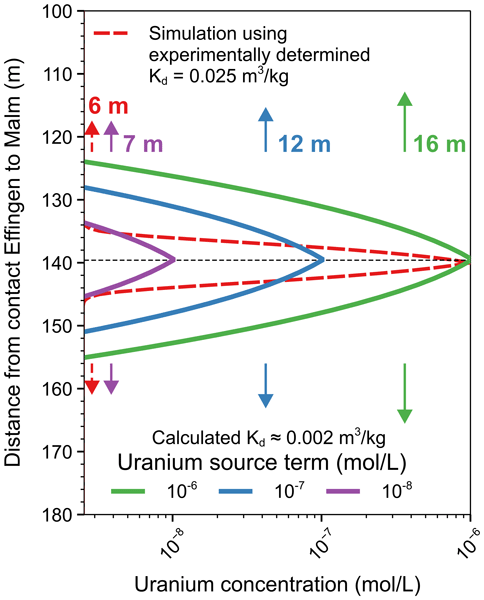
Uranium migration for a close to real case situation is quantified with reactive transport simulations using input data from the deep geothermal borehole Schlattingen, which is near the targeted area in Switzerland, and including the effect of the multi-barrier system on the source term. The hydrogeological system must always be considered in safety assessments since adjacent aquifers have a major impact on the pore water geochemistry, and hence sorption processes.
Theresa Hennig and Michael Kühn
Saf. Nucl. Waste Disposal, 2, 147–147, https://doi.org/10.5194/sand-2-147-2023, https://doi.org/10.5194/sand-2-147-2023, 2023
Short summary
Short summary
Migration of uranium in the potential host rock Opalinus Clay is used as an example to demonstrate the extent to which simulated migration lengths can vary for a million years, depending on the model concept and on the underlying data and parameters. To reduce the uncertainty in this context, the calcite carbonate ion and the hydrogeological system at a potential disposal site need to be known, whereas the quantity of clay minerals plays a subordinate role, as long as it is enough.
Theresa Hennig and Michael Kühn
Adv. Geosci., 58, 11–18, https://doi.org/10.5194/adgeo-58-11-2022, https://doi.org/10.5194/adgeo-58-11-2022, 2022
Short summary
Short summary
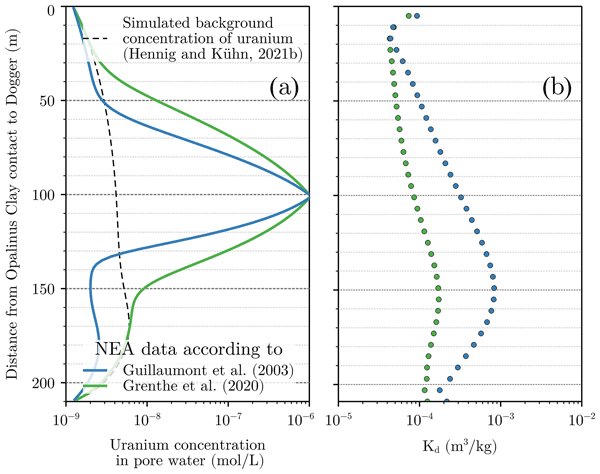
Safety assessments must demonstrate that radionuclides in potential disposal sites are retained within the containment providing rock zone using reactive transport simulations. Here, this is quantified for the example of uranium in the hydrogeological system of the Opalinus Clay at Mont Terri. Our work clearly shows how sensitive migration lengths resulting from simulations are to the model conceptualisation and selection of underlying data.
Theresa Hennig and Michael Kühn
Adv. Geosci., 56, 97–105, https://doi.org/10.5194/adgeo-56-97-2021, https://doi.org/10.5194/adgeo-56-97-2021, 2021
Short summary
Short summary
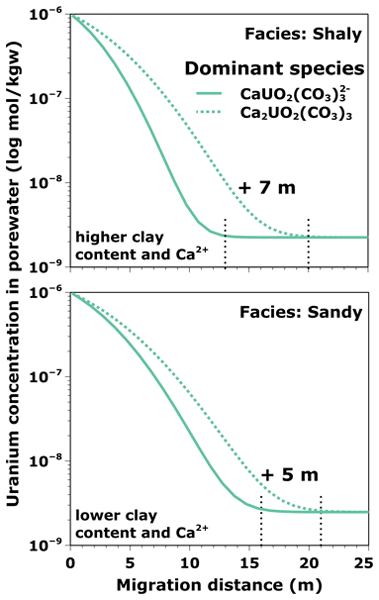
Uranium migration in the Swiss Opalinus Clay is used as an example to quantify the influence of varying values of a stability constant in the underlying thermodynamic database within the law of mass action on the migration lengths. The difference of the stability constant of 1.33 log units lead to changed migration lengths of 5 m to 7 m. With a maximum diffusion distance of 22 m the influence of an uncertain stability constant is negligible for the host rock scale.
Cited articles
Altmann, S.: “Geo”chemical Research: A Key Building Block for Nuclear Waste Disposal Safety Cases, Journal of Contaminant Hydrology, 102, 174–179, https://doi.org/10.1016/j.jconhyd.2008.09.012, 2008. a
Altmann, S., Tournassat, C., Goutelard, F., Parneix, J. C., Gimmi, T., and Maes, N.: Diffusion-Driven Transport in Clayrock Formations, Applied Geochemistry, 27, 463–478, https://doi.org/10.1016/j.apgeochem.2011.09.015, 2012. a
Bonitz, M., Hennig, T., Schleicher, A. M., Jaeggi, D., Stammeier, J. A., Ostertag-Henning, C., and Kühn, M.: Bulk Rock Geochemical and Mineralogical Characterisation of Clay-Rich Sediments from Drill Core Analysis of the Staffelegg Formation, Applied Geochemistry, 186, 106389, https://doi.org/10.1016/j.apgeochem.2025.106389, 2025. a
Bradbury, M. H. and Baeyens, B.: Porewater Chemistry in Compacted Re-Saturated MX-80 Bentonite: Physico-Chemical Characterisation and Geochemical Modelling, Tech. rep., PSI, Villingen, Switzerland, ISSN 1015-2636, 2002. a
Bradbury, M. H. and Baeyens, B.: Experimental and Modelling Investigations on Na-illite: Acid-base Behaviour and the Sorption of Strontium, Nickel, Europium and Uranyl, Nagra Technical Report, NTB 04-02, ISSN 1015-2636, 2005a. a
Bradbury, M. H. and Baeyens, B.: Modelling the Sorption of Mn(II), Co(II), Ni(II), Zn(II), Cd(II), Eu(III), Am(III), Sn(IV), Th(IV), Np(V) and U(VI) on Montmorillonite: Linear Free Energy Relationships and Estimates of Surface Binding Constants for Some Selected Heavy Metals and Actinide, Geochimica et Cosmochimica Acta, 69, 875–892, https://doi.org/10.1016/j.gca.2004.07.020, 2005b. a, b
Bradbury, M. H. and Baeyens, B.: Sorption Modelling on Illite Part I: Titration Measurements and the Sorption of Ni, Co, Eu and Sn, Geochimica et Cosmochimica Acta, 73, 990–1003, https://doi.org/10.1016/j.gca.2008.11.017, 2009. a, b
Bradbury, M. H. and Baeyens, B.: The Development of a Thermodynamic Sorption Data Base for Illite and the Application to Argillaceous Rocks, Tech. rep., ISSN 1015-2636, 2017. a
Charlton, S. R. and Parkhurst, D. L.: Modules Based on the Geochemical Model PHREEQC for Use in Scripting and Programming Languages, Computers & Geosciences, 37, 1653–1663, https://doi.org/10.1016/j.cageo.2011.02.005, 2011. a
Freivogel, M. and Huggenberger, P.: Modellierung Bilanzierter Profile Im Gebiet Mont Terri – La Croix (Kanton Jura), in: Reports of the FOWG, Geology Series, No 4.: Mont Terri Project – Geology, Paleohydrology and Stress Field of the Mont Terri Region, 7–44, ISBN 3-906723-58-5, 2003. a
Geckeis, H., Lützenkirchen, J., Polly, R., Rabung, T., and Schmidt, M.: Mineral–Water Interface Reactions of Actinides, Chemical Reviews, 113, 1016–1062, https://doi.org/10.1021/cr300370h, 2013. a
Gimmi, T., Aschwanden, L., Waber, H. N., Gaucher, E. C., Ma, J., and Traber, D.: Profiles of δ18O and δ2H in Porewater of a Mesozoic Rock Sequence: Regional Variability and Relation to Large-Scale Transport Regimes, Applied Geochemistry, 160, https://doi.org/10.1016/j.apgeochem.2023.105846, 2024. a, b
Hennig, T. and Kühn, M.: Surrogate Model for Multi-Component Diffusion of Uranium through Opalinus Clay on the Host Rock Scale, Applied Sciences (Switzerland), 11, 1–21, https://doi.org/10.3390/app11020786, 2021b. a, b
Hennig, T. and Kühn, M.: Uranium migration lengths in Opalinus Clay depend on geochemical gradients, radionuclide source term concentration and pore water composition, Advances in Geosciences, 62, 21–30, https://doi.org/10.5194/adgeo-62-21-2023, 2023. a, b
Hennig, T., Stockmann, M., and Kühn, M.: Simulation of Diffusive Uranium Transport and Sorption Processes in the Opalinus Clay, Applied Geochemistry, 123, https://doi.org/10.1016/j.apgeochem.2020.104777, 2020. a, b, c, d
Horita, J., Zimmermann, H., and Holland, H. D.: Chemical Evolution of Seawater during the Phanerozoic: Implications from the Record of Marine Evaporites, Geochimica et Cosmochimica Acta, 66, 3733–3756, https://doi.org/10.1016/S0016-7037(01)00884-5, 2002. a
Joseph, C., Schmeide, K., Sachs, S., Brendler, V., Geipel, G., and Bernhard, G.: Sorption of Uranium(VI) onto Opalinus Clay in the Absence and Presence of Humic Acid in Opalinus Clay Pore Water, Chemical Geology, 284, 240–250, https://doi.org/10.1016/j.chemgeo.2011.03.001, 2011. a
Joseph, C., Stockmann, M., Schmeide, K., Sachs, S., Brendler, V., and Bernhard, G.: Sorption of U(VI) onto Opalinus Clay: Effects of pH and Humic Acid, Applied Geochemistry, 36, 104–117, https://doi.org/10.1016/j.apgeochem.2013.06.016, 2013a. a, b
Joseph, C., Van Loon, L. R., Jakob, A., Steudtner, R., Schmeide, K., Sachs, S., and Bernhard, G.: Diffusion of U(VI) in Opalinus Clay: Influence of Temperature and Humic Acid, Geochimica et Cosmochimica Acta, 109, 74–89, https://doi.org/10.1016/j.gca.2013.01.027, 2013b. a, b
Keesmann, S., Noseck, U., Buhmann, D., Fein, E., and Schneider, A.: Modellrechnungen Zur Langzeitsicherheit von Endlagern in Salz- Und Granitformationen, Tech. Rep. GRS-206, Gesellschaft für Anlagen- und Reaktorsicherheit (GRS) mbH, ISBN 3931995739, 2005. a
Koroleva, M., Alt-Epping, P., and Mazurek, M.: Large-Scale Tracer Profiles in a Deep Claystone Formation (Opalinus Clay at Mont Russelin, Switzerland): Implications for Solute Transport Processes and Transport Properties of the Rock, Chemical Geology, 280, 284–296, https://doi.org/10.1016/j.chemgeo.2010.11.016, 2011. a
Marques Fernandes, M., Vér, N., and Baeyens, B.: Predicting the Uptake of Cs, Co, Ni, Eu, Th and U on Argillaceous Rocks Using Sorption Models for Illite, Applied Geochemistry, 59, 189–199, https://doi.org/10.1016/j.apgeochem.2015.05.006, 2015. a
Mazurek, M. and de Haller, A.: Pore-Water Evolution and Solute-Transport Mechanisms in Opalinus Clay at Mont Terri and Mont Russelin (Canton Jura, Switzerland), Swiss Journal of Geosciences, 110, 129–149, https://doi.org/10.1007/s00015-016-0249-9, 2017. a, b
Mazurek, M., Alt-Epping, P., Bath, A., Gimmi, T., Niklaus Waber, H., Buschaert, S., Cannière, P. D., Craen, M. D., Gautschi, A., Savoye, S., Vinsot, A., Wemaere, I., and Wouters, L.: Natural Tracer Profiles across Argillaceous Formations, Applied Geochemistry, 26, 1035–1064, https://doi.org/10.1016/j.apgeochem.2011.03.124, 2011. a, b, c, d, e, f, g, h, i, j
Mazurek, M., Gimmi, T., Zwahlen, C., Aschwanden, L., Gaucher, E. C., Kiczka, M., Rufer, D., Wersin, P., Fernandes, M. M., Glaus, M. A., Van Loon, L. R., Traber, D., Schnellmann, M., and Vietor, T.: Swiss Deep Drilling Campaign 2019–2022: Geological Overview and Rock Properties with Focus on Porosity and Pore-Space Architecture, Applied Geochemistry, 159, 105839, https://doi.org/10.1016/j.apgeochem.2023.105839, 2023a. a, b
Mazurek, M., Wersin, P., Hadi, J., Grenèche, J.-M., Prinpreecha, N., and Traber, D.: Geochemistry and Palaeo-Hydrogeology of the Weathered Zone in the Opalinus Clay, Applied Clay Science, 232, 106793, https://doi.org/10.1016/j.clay.2022.106793, 2023b. a, b
Mazurek, M., Wersin, P., Eichinger, F., Bath, A., Al, T., Clark, I. D., Kennell-Morrison, L., Kampman, N., and Traber, D.: Techniques for Porewater Extraction from Clayrocks, Applied Clay Science, 273, 107855, https://doi.org/10.1016/j.clay.2025.107855, 2025. a
Müller, M.: PhreeqPy – Python Tools for PHREEQC, https://www.phreeqpy.com (last access: 9 February 2026), 2025. a
Müller, M., Parkhurst, D. L., and Charlton, S. R.: Programming PHREEQC Calculations with C++ and Python – A Comparative Study, in: Proceedings for MODFLOW and More 2011: Integrated Hydrologic Modeling, Golden, Colorado, 632–636, https://www.phreeqpy.com/Mueller_etal_MODFLOWandMORE2011_Proceedings.pdf (last access: 9 February 2026), 2011. a
Pearson, F. J., Arcos, D., Bath, A., Boisson, J.-Y., Fernández, A. M., Gäbler, H. E., Gaucher, E. C., Gautschi, A., Griffault, L., Hernán, P., and Waber, H. N.: Mont Terri Project – Geochemistry of Water in the Opalinus Clay Formation at the Mont Terri Rock Laboratory, Tech. Rep. 5, Federal Office for Water and Geology, FOWG, Bern, Switzerland, ISBN 3-906723-59-3, 2003. a, b, c, d, e
Pearson, F. J., Tournassat, C., and Gaucher, E. C.: Biogeochemical Processes in a Clay Formation in Situ Experiment: Part E – Equilibrium Controls on Chemistry of Pore Water from the Opalinus Clay, Mont Terri Underground Research Laboratory, Switzerland, Applied Geochemistry, 26, 990–1008, https://doi.org/10.1016/j.apgeochem.2011.03.008, 2011. a
Philipp, T., Shams Aldin Azzam, S., Rossberg, A., Huittinen, N., Schmeide, K., and Stumpf, T.: U(VI) Sorption on Ca-bentonite at (Hyper)Alkaline Conditions – Spectroscopic Investigations of Retention Mechanisms, Science of The Total Environment, 676, 469–481, https://doi.org/10.1016/j.scitotenv.2019.04.274, 2019. a
Schmassmann, H.: Hydrochemische Synthese Nordschweiz: Tertiär- und Malm-Aquifere, Technical Report 88-07, Nagra, 1990. a
Schmassmann, H., Kullin, M., and Schneemann, K.: Hydrochemische Synthese Nordschweiz: Buntsandstein-, Perm- und Kristallin-Aquifere, Technical Report 91-30, Nagra, 1992. a
Steinthorsdottir, M., Jeram, A. J., and McElwain, J. C.: Extremely Elevated CO2 Concentrations at the Triassic/Jurassic Boundary, Palaeogeography, Palaeoclimatology, Palaeoecology, 308, 418–432, https://doi.org/10.1016/j.palaeo.2011.05.050, 2011. a
Stober, I., Wolfgramm, M., and Birner, J.: Hydrochemie der Tiefenwässer in Deutschland, Journal for Geological Sciences, 41/42, 339–380, 2014. a
Stockmann, M., Schikora, J., Becker, D. A., Flügge, J., Noseck, U., and Brendler, V.: Smart Kd-values, Their Uncertainties and Sensitivities – Applying a New Approach for Realistic Distribution Coefficients in Geochemical Modeling of Complex Systems, Chemosphere, 187, 277–285, https://doi.org/10.1016/j.chemosphere.2017.08.115, 2017. a
Waber, H. N. and Rufer, D.: Pore Water Geochemistry, Method Comparison and Opalinus Clay – Passwang Formation Interface Study at the Mont Terri URL, Tech. Rep. NWMO-TR-2017-10, Nuclear Waste Management Organization, 2017. a
Wersin, P., Mazurek, M., Mäder, U. K., Gimmi, T., Rufer, D., Lerouge, C., and Traber, D.: Constraining Pore Water Chemistry in a 250 m Thick Argillaceous Rock Sequence, Chemical Geology, 434, 43–61, https://doi.org/10.1016/j.chemgeo.2016.04.006, 2016. a, b
Wersin, P., Gimmi, T., Mazurek, M., Alt-Epping, P., Pękala, M., and Traber, D.: Multicomponent Diffusion in a 280 m Thick Argillaceous Rock Sequence, Applied Geochemistry, 95, 110–123, https://doi.org/10.1016/j.apgeochem.2018.05.013, 2018. a
Wersin, P., Mazurek, M., and Gimmi, T.: Pore Water Chemistry of Opalinus Clay Revisited: Findings from 25 Years of Data Collection at the Mont Terri Rock Laboratory, Applied Geochemistry, 138, 105234, https://doi.org/10.1016/j.apgeochem.2022.105234, 2022. a, b, c
Wersin, P., Gimmi, T., Ma, J., Mazurek, M., Zwahlen, C., Aschwanden, L., Gaucher, E., and Traber, D.: Pore Water Profiles of Cl and Br in Boreholes Penetrating the Mesozoic Sequence in Northern Switzerland, Applied Geochemistry, 159, 105845, https://doi.org/10.1016/j.apgeochem.2023.105845, 2023. a, b, c, d, e, f, g, h
Yang, J., Liu, H., Tang, Z., Peeters, L., and Ye, M.: Visualization of Aqueous Geochemical Data Using Python and WQChartPy, Groundwater, 60, 555–564, https://doi.org/10.1111/gwat.13185, 2022. a
Short summary
We studied how the chemical composition of water in rocks affects the movement of uranium, which is important for the safety of nuclear waste disposal sites. Using computer models, we found that water chemistry inside the host rock for the waste is more decisive for the transport of uranium than groundwater chemistry in adjacent rocks. These findings help improve site selection for a disposal site by indicating which conditions are suitable and less suitable to safely isolate radioactive waste.
We studied how the chemical composition of water in rocks affects the movement of uranium, which...


