
 | 12 Feb 2026
Pore water or groundwater chemistry: what governs uranium migration in Opalinus Clay?
Tim Schöne
Theresa Hennig
Pore water in the containment providing rock zone (CRZ) and groundwater from the surrounding aquifers provide the chemical initial conditions and boundaries for reactive transport simulations of radionuclide migration in the context of radioactive waste disposal. Hydrochemical differences between the two hydrogeological domains lead to gradients in the pore water profile across the CRZ, which affect sorption, diffusion, and thus migration of radionuclides such as uranium. However, pore water and groundwater compositions differ on the spatial and temporal scales relevant to safety assessments. To quantify the impact of this variability, we performed one-dimensional reactive transport simulations of uranium migration through Opalinus Clay using the geochemical code PHREEQC, varying both initial and boundary conditions. Our results show that uranium migration distances differ by several decametres over one million years depending on the initial pore water composition in the CRZ. Variations in groundwater chemistry only affect natural uranium concentrations close to the contacts between CRZ and its bounding aquifers. Consequently, the pore water composition in the CRZ is more decisive for uranium migration than hydrochemical variations in embedding aquifers.
- Article
(4960 KB) - Full-text XML
- BibTeX
- EndNote


Pore water chemistry controls the transport of radionuclides (Altmann et al., 2012) through the containment providing rock zone (CRZ) and is influenced by the entire hydrogeological system (Hennig and Kühn, 2021a). Numerical simulations of uranium migration in Opalinus Clay over one million years show that the pore water composition has a more substantial impact on uranium migration than variations in clay mineral quantity (Hennig et al., 2020). This is because the partial pressure of carbon dioxide pCO2, pH, redox potential and the concentrations of complexing ligands determine the speciation, and thus sorption of uranium, which is present in the Opalinus Clay mainly in mobile ternary uranyl complexes with calcium, magnesium and carbonate (Joseph et al., 2011, 2013a; Geckeis et al., 2013; Philipp et al., 2019; Hennig et al., 2020; Hennig and Kühn, 2021b). Moreover, Hennig and Kühn (2021a) demonstrate that inherent gradients in the profile of pore water chemistry across the CRZ can significantly increase uranium migration distances compared to a setting with constant pore water composition (Hennig and Kühn, 2023). The former case is observed in the region of the Mont Terri anticline (Pearson et al., 2003; Mazurek et al., 2011). Over the course of a few million years, diffusive exchange between the more saline pore water in the CRZ and the less saline groundwater in adjacent aquifers resulted in a pronounced gradient in present-day pore water chemistry (Fig. 1; Mazurek et al., 2011). The pore water composition is affected by interactions in the hydrogeological system and determines speciation, and hence sorption and migration of uranium through the CRZ.
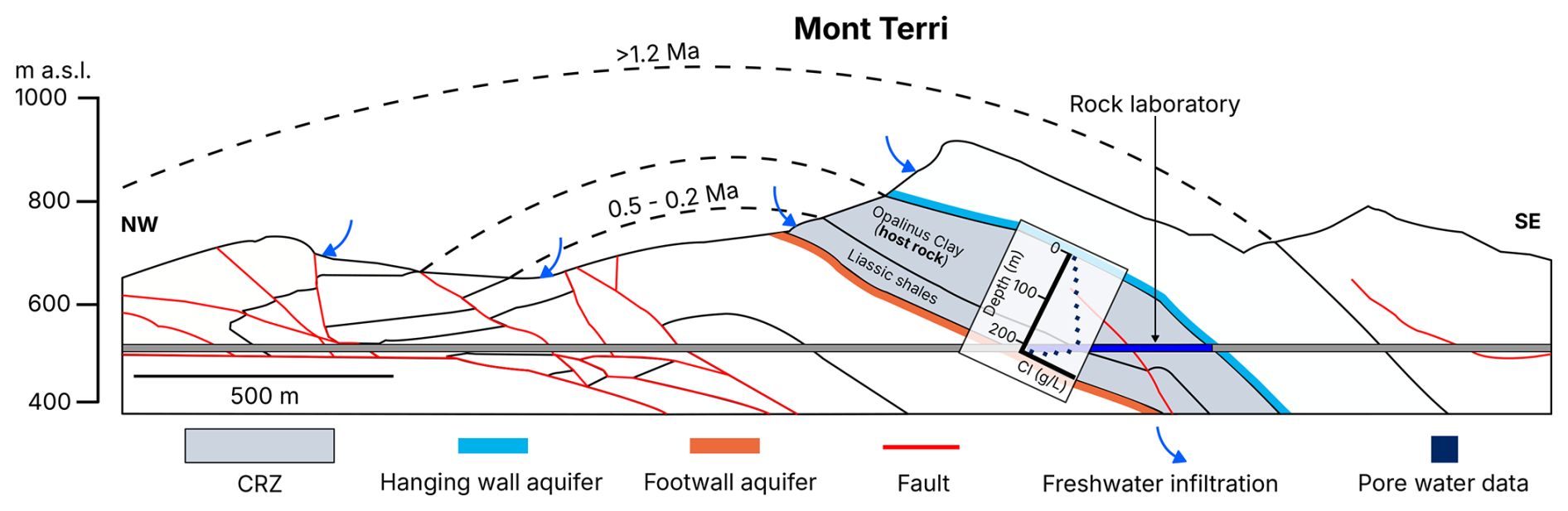
Figure 1Erosion history of the Mont Terri anticline and formation of the present hydrogeological system. Freshwater infiltration into the hanging wall (Dogger limestone, blue) and footwall (Liassic Gryphaea limestone, orange) aquifers surrounding the containment providing rock zone (CRZ) consisting of Opalinus Clay and Liassic shales caused the development of a pronounced gradient in the profile of pore water chemistry (Mazurek et al., 2011). This is schematically illustrated in the inset for the vertical chloride concentration profile (blue squares) based on the data from Pearson et al. (2003). Modified from Freivogel and Huggenberger (2003).
Pore water composition in the Opalinus Clay is subject to variations on the formation scale. For example, profiles of pore water chemistry observed at the proposed Swiss siting region “Nördlich Lägern” show little variability compared to the situation at Mont Terri (Wersin et al., 2023; Gimmi et al., 2024). In addition, pore water compositions differ between the three investigated siting regions “Jura Ost”, “Zürich Nordost” and “Nördlich Lägern” (Wersin et al., 2023; Mazurek et al., 2023a) despite their spatial proximity to each other. This illustrates that pore water chemistry profiles can exhibit considerable variability within a formation, which is mainly a consequence of interactions between pore water and regional differences with respect to surrounding aquifers (Wersin et al., 2023). The geological and paleohydrogeological evolution at a specific site determines whether and to which degree these interactions take place (Mazurek et al., 2011, 2023b; Mazurek and de Haller, 2017). Shapes of pore water profiles differ depending on the properties of the CRZ, compositions of embedding groundwater-bearing units, and duration of the interaction (Mazurek et al., 2009). A site-specific characterisation is therefore essential as data for pore water chemistry represent the initial conditions for simulations of radionuclide migration.
Groundwaters from aquifers surrounding the CRZ provide the model boundary conditions, which are not constant, neither in space nor in time. For the Opalinus Clay formation, variations in groundwater composition in adjacent aquifers can be expected on a regional scale due to varying and generally higher permeabilities in these units, dominance of advection, mixing of waters with different residence times and chemical signatures as well as lithological and mineralogical heterogeneity (Nagra, 2002; Wersin et al., 2023). Long-term climatic and geological developments on time scales relevant to safety assessments may cause perturbations in the hydrogeological and geochemical regime (Nagra, 2002), and thus change the composition of groundwaters in aquifers bounding the CRZ.
We evaluate the chemical variability of pore water and groundwater and their associated impact on transport processes in the context of safety assessments for radioactive waste disposal. The variability of pore water and groundwater compositions poses an uncertainty for safety assessments as long-term integrity of a CRZ is favoured by stable conditions (Altmann, 2008). Thus, the uncertainty must be quantified to be adequately accounted for in the site selection processes. In this respect, Hennig and Kühn (2023) studied the influence of different profiles of pore water chemistry, i.e. model initial conditions, on uranium migration. Building upon this, we perform fully coupled reactive transport simulations to systematically analyse the effects of varying boundary conditions on uranium migration at different initial conditions.
Reactive transport simulations are performed on the host rock scale to quantify the sensitivity of uranium migration to the variability of the pore water in the CRZ and groundwater in the surrounding aquifers. The initial conditions in the models refer to the pore water chemistry and the boundary conditions to the groundwater chemistry. The conceptual model is based on one-dimensional simulations conducted by Hennig and Kühn (2021a) using PHREEQC version 3.8.6 (Parkhurst and Appelo, 2013). The open source software module PhreeqPy (Müller et al., 2011; Müller, 2025), version 0.5.1, is used to access PHREEQC via the IPhreeqc interface (Charlton and Parkhurst, 2011). This enables working with PHREEQC in Python-based frameworks. The PSI Thermodynamic Database 2020 version 1.5 (Hummel and Thoenen, 2023) is used. Surface complexation data describing the sorption of hydroxo-complexes of uranium onto illite and montmorillonite are included (Bradbury and Baeyens, 2005a, b, 2009). A more detailed description of the implementation of the surface reactions can be found in Supplementary 1 of Hennig et al. (2020). The Specific Ion Interaction Theory (SIT) is applied to represent ion-ion interactions in the model (Hummel and Thoenen, 2023). All simulations are carried out isothermally for a reference temperature of 25 °C in line with the thermodynamic database. Temperature variations are to be expected on the host rock scale. However, Wersin et al. (2016) showed that the effect of higher temperatures on the concentration of most pore water components is <5 %. An exception to this is the alkalinity, which is reduced by 35 % at 45 °C compared to room temperature due to retrograde calcite solubility. Although elevated temperatures are associated with enhanced diffusion, the impact on the overall migration of uranium is only minor as sorption increases as well (Joseph et al., 2013b).
The model domain is deduced from the hydrogeological system of the Mont Terri anticline (Fig. 1). Liassic shales and the Opalinus Clay make up the 210 m thick CRZ, which is surrounded by aquifers at the footwall (Liassic Gryphaea limestone) and hanging wall (Dogger limestone). Freshwater infiltrated, and thus activated the current hydrogeological boundaries after an uplift of the anticline about 10 Ma ago and subsequent erosion (Pearson et al., 2003; Mazurek et al., 2011). Hydraulic rock properties correspond to the direction perpendicular to bedding and are kept constant across the model domain. The Opalinus Clay at Mont Terri contains the clay minerals illite, interstratified illite-smectite, kaolinite, and chlorite (Bossart and Thury, 2008). Illite and interstratified illite-smectite are considered as main mineral phases for sorption in the model. This means, kaolinite and chlorite are not included. Averaged quantities for illite (23 wt %) and interstratified illite-smectite (10 wt %) are applied to the entire CRZ based on analyses from Mont Terri (Bossart and Thury, 2008). It is assumed that the interstratified illite-smectite minerals consist of 50 % illite and 50 % smectite. Montmorrilonite is used to represent the smectite component. The individual quantities of illite and montmorillonite as well as the values for the hydraulic rock properties are equal to Hennig and Kühn (2021a) and given in Fig. 2. The model boundaries are defined by the water composition of the embedding aquifers as Dirichlet conditions.
The fully coupled, process-based model includes diffusion, cation exchange, surface complexation and interactions with inherent minerals. Diffusion processes are quantified following Fick's second law using the pore water diffusion coefficient DP for uranium of 1.2 × 10¹¹ m2 s−1, which was derived from the experimentally determined effective diffusion coefficient De of 1.9 × 10⁻¹² m2 s−1 (Joseph et al., 2013a) and the effective porosity ϵ of 16 %, . Sorption is integrated via a bottom-up approach (Marques Fernandes et al., 2015; Stockmann et al., 2017) using non-electrostatic surface complexation models and cation exchange (Bradbury and Baeyens, 2002, 2005b, 2009, 2017). Illite and montmorillonite are the cation exchange and surface complexation phases, which are initially equilibrated with the pore water solution. The Donnan approach is applied to balance the surface charge of the clay minerals (Parkhurst and Appelo, 2013). In addition, pyrite, siderite, calcite and dolomite, which are omnipresent in Opalinus Clay, are specified to be in equilibrium with the pore water solution. The mineral assemblage controls the pH and redox conditions (Pearson et al., 2003, 2011; Wersin et al., 2022). The partial pressure of carbon dioxide pCO2 controls the calcite-carbonate system, and hence affects the pore water chemistry. Throughout the model domain, pCO2 is initially fixed to a value of 10−2.7 bar (Hennig and Kühn, 2021a). This resembles the atmospheric pCO2 at the time of deposition of the Opalinus Clay close to the Triassic-Jurassic boundary (Steinthorsdottir et al., 2011). A constant uranium source term of about 1 µmol L−1 (Keesmann et al., 2005; Joseph et al., 2013b; Hennig and Kühn, 2021a) is implemented in the model centre via a mineral equilibrium with uraninite (UO2) to mimic a radioactive waste repository with failed high-level waste canisters. Natural uranium background concentrations in the pore water of the CRZ are established in the model by a fixed undersaturation with regard to UO2. The applied process-coupling, model configuration and constraints have been verified in Hennig et al. (2020) and Hennig and Kühn (2021a, b) and are schematically illustrated in Fig. 2.
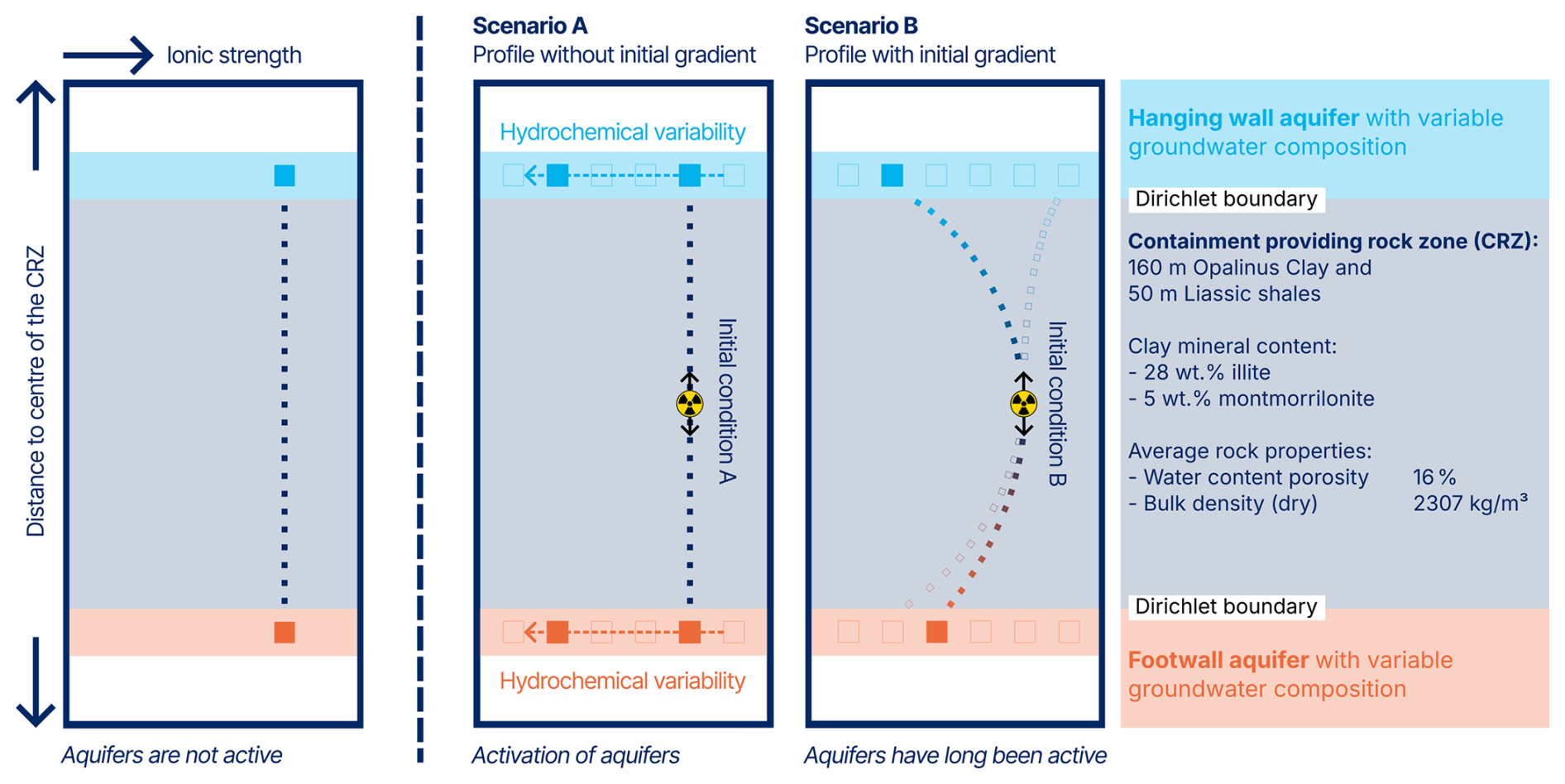
Figure 2Schematic illustration of the study concept and definition of the conceptual model according to Hennig and Kühn (2021a). Boundary conditions are varied in two scenarios (A, B), which differ in terms of the initial profiles of pore water chemistry. The radioactive waste repository is represented by a constant uranium source term in the model centre. Simulations run for one million years and are compared with the reference case for Mont Terri (Hennig and Kühn, 2021a) to quantify the effect of variability in pore water and groundwater composition on uranium migration.
We carry out simulations for two different initial conditions to evaluate the effect of variability in the pore water chemistry and to compare this with the effect of variable boundary conditions. Scenario A describes a profile with initially constant pore water chemistry throughout the CRZ. The absence of any vertical variability is a theoretical end member of possible pore water profiles. In a strongly simplified form, scenario A represents the situation observed in some boreholes at the Swiss siting region “Nördlich Lägern”, where only low gradients in pore water chemistry profiles prevail. This indicates long-term diffusive equilibration and the absence of recent geological disturbances (Wersin et al., 2023), such as a change in the hydrochemical regime of aquifers surrounding the CRZ. A similar setting likely prevailed at the Mont Terri anticline around six million years ago, when the bounding Dogger and Liassic formations had not yet been eroded on the surface (Mazurek et al., 2011). Therefore, the variability in pore water composition is not only spatial. It is also temporal in nature, because the systems can evolve and change with time as it was and is the case at Mont Terri. For the simulations of scenario A, concentrations of the main pore water components prior to the activation of the aquifers are required as initial conditions. As the Opalinus Clay formation was deposited in a marine environment, Hennig and Kühn (2021a) used seawater concentrations according to the time of deposition in the Jurassic (Horita et al., 2002) for some of the main constituents. For the remaining components, measured values from a stagnant water sample from Mont Russelin (Koroleva et al., 2011; Mazurek et al., 2011), which is considered to be unaffected by diffusive exchange, are used to approximate the original pore water composition. The solution composition is initially equilibrated with the mineral assemblage, cation exchange and surface complexation phases mentioned above. This accounts for the water-rock interactions that have characterised and superimposed the pore water chemistry since deposition. The measured present-day hydrogeological system at Mont Terri with its pronounced inherent gradient in the profile of pore water chemistry is used as initial condition for scenario B. To derive this, the initial state of scenario A with an unaffected and constant pore water composition is assumed, i.e. the aquifers bounding the CRZ have not yet been activated. Infiltration of freshwater into the hanging wall (Dogger limestone) and footwall aquifers (Liassic Gryphaea limestone) is then simulated over a total simulation time of six million years in line with the paleohydrogeological evolution of the Mont Terri anticline (Mazurek et al., 2011). The precise procedure including the model calibration and validation is described in further detail in Hennig and Kühn (2021a). The initial conditions represented by the scenarios A and B can be regarded as end members of the possible pore water composition in the Opalinus Clay formation (including its low permable confining units) according to current knowledge. Intermediate states between these end members are also known, for example from the Swiss siting regions of “Jura Ost” and “Zürich Nordost” (Wersin et al., 2023) and the deep borehole Schlattingen (Fig. 3; Wersin et al., 2016, 2018). The chosen scenarios for initial conditions therefore represent the range of expectable pore water profiles, from constant to strongly pronounced gradients (Fig. 2).
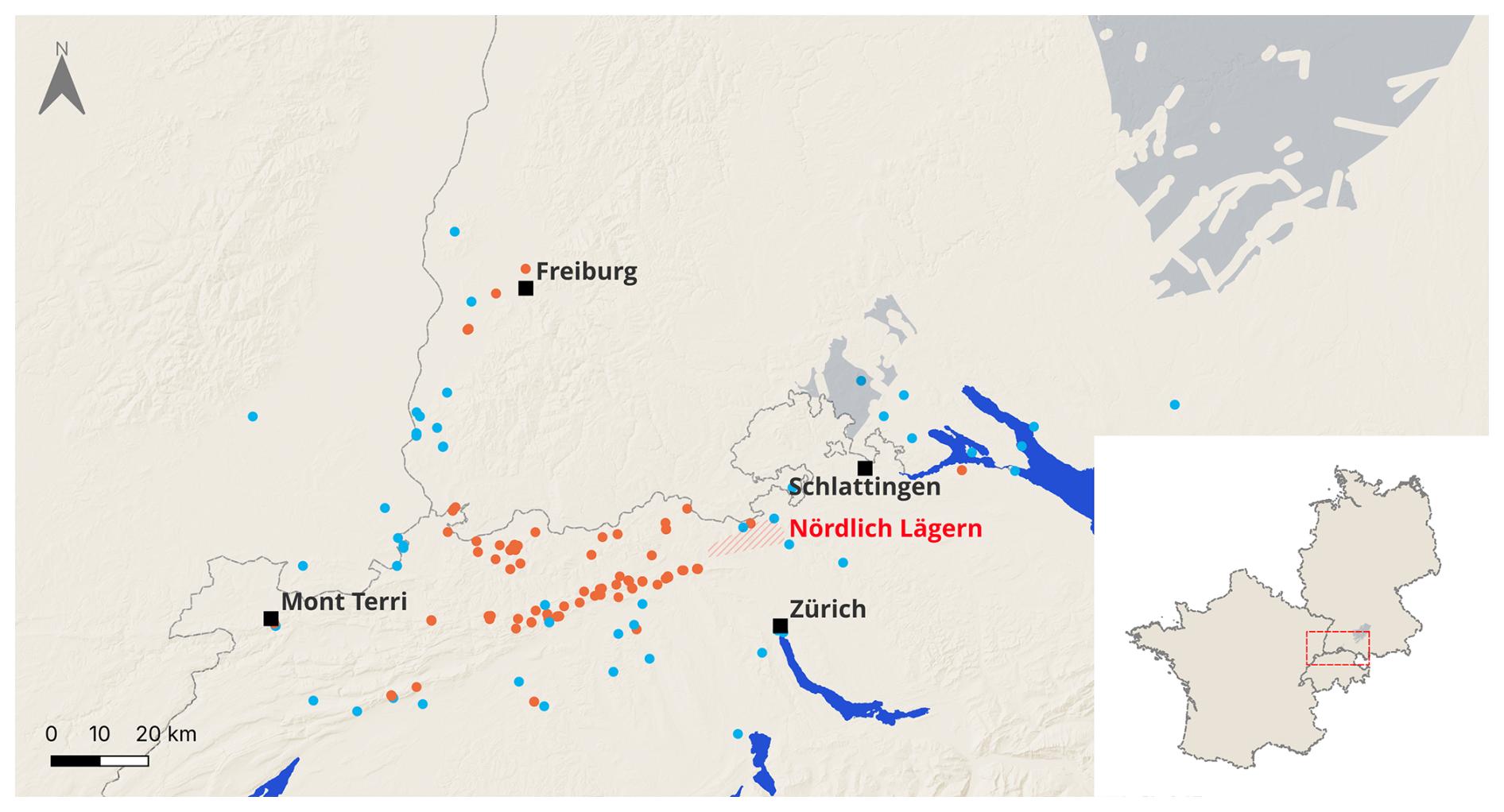
Figure 3Groundwater compositions of samples from the border triangle of Switzerland, Germany and France are used as boundary conditions in the simulations. Chemical data of groundwater from the Dogger, Hauptrogenstein and Malm formations are summarised as hanging wall aquifer (blue dots), data from the Liassic, Keuper and Muschelkalk as footwall aquifer (orange dots). The red-hatched area marks the outline of the Swiss siting region “Nördlich Lägern”. Areas displayed in grey in the upper right quarter of the map highlight parts of a sub-area in the German site selection process that include the Opalinus Clay (BGE, 2020).
The boundary conditions are varied in the simulations in order to examine the effect of chemical variability in groundwaters from aquifers surrounding the CRZ on uranium migration. Groundwater data from local and regional water-bearing layers of the Dogger, Hauptrogenstein and Malm formations overlying the Opalinus Clay (hanging wall aquifers) as well as Liassic, Keuper and Muschelkalk formations underlying the low permeable rock sequence (footwall aquifers) are compiled from Schmassmann (1990) and Schmassmann et al. (1992). This data is derived from comprehensive hydrochemical syntheses of sampled groundwaters from the Molasse region in northern Switzerland and border areas in Germany and France (Fig. 3). Hence, it reflects the uncertainty that is associated with the chemical variability of these waters on a regional scale with a population of 212 samples. The analysed waters cover a depth range from near-surface to deep groundwaters (up to 2000 m depth) and originate from formations of regional extent, which reach into areas in southern Germany that are relevant for the German site selection process (BGE, 2020). Measured parameters include the major ions sodium, potassium, magnesium, calcium, sulphate, chloride as well as alkalinity, pH, water temperature, redox potential and, not consistently available, ion concentrations of uranium, iron and strontium. This parameter scope corresponds to the groundwater components measured today at Mont Terri and used for the reference simulations (Hennig and Kühn, 2021a). Each of the 212 compiled groundwater samples is applied as a constant boundary condition at the respective hanging wall or footwall boundary of the model in a single simulation over one million years. This causes a hydrochemical disturbance in the system, which in response triggers a change in the initially defined pore water conditions during the course of the simulations. A total of 424 simulations are performed, 212 for each scenario. In summary, model boundary conditions are varied within a range covering the spatial uncertainty related to the groundwater chemistry in aquifers embedding the CRZ in northern Switzerland and southern Germany.
Groundwater samples from aquifers in the Molasse region reveal a broad spectrum of chemical compositions ranging from Ca-HCO3 to Na-Cl water types (Fig. 4). Some of these groundwaters differ significantly from those in the surrounding units of the CRZ at Mont Terri. Samples from the aquifers underlying the Opalinus Clay and its bounding low permeable units tend to have higher chloride contents. This variability is also reflected in the ionic strengths of the waters that cover several orders of magnitude from less than 0.01 to more than 1 mol L−1.
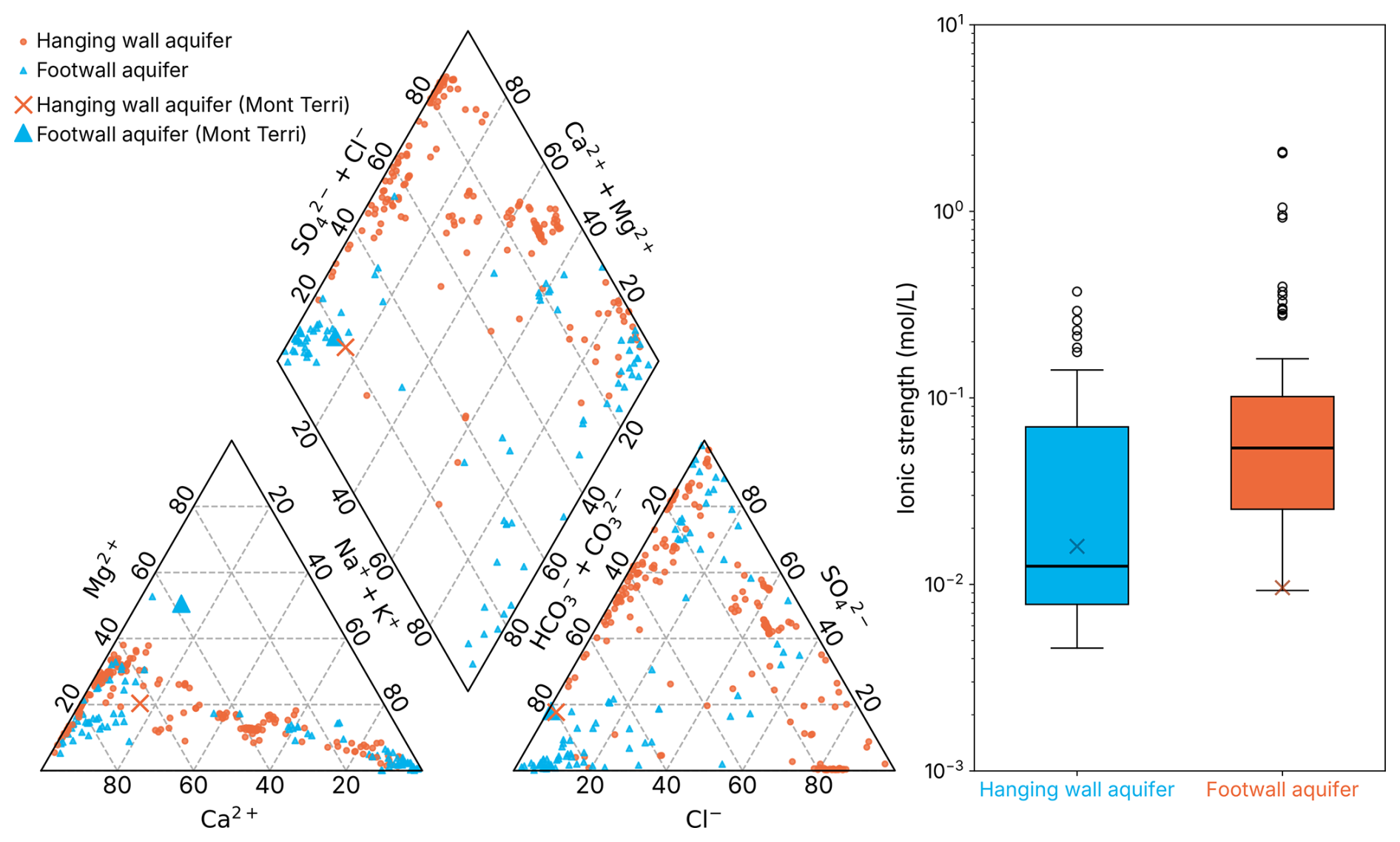
Figure 4Investigated groundwater samples cover a broad spectrum of water types, as can be seen in the Piper plot, which was created using the Python package “WQChartPy” by Yang et al. (2022). Ionic strengths of the sampled waters cover several orders of magnitude, with the mean value and range being higher in the footwall than in the hanging wall aquifers.
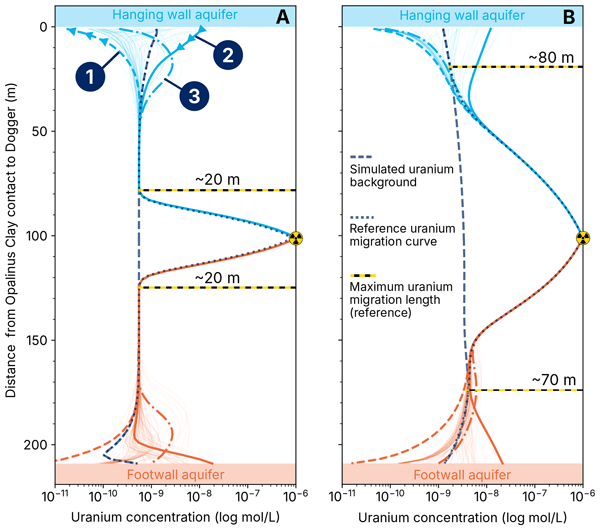
Uranium migration distances through the CRZ differ by several decametres depending on the initial profile of pore water chemistry. With initially constant pore water conditions in the low permeable rock sequence (scenario A), uranium migrates approximately 20 m from the model centre in both directions towards the bounding units of the Dogger and Liassic Gryphaea limestones (Fig. 5). Migration distances increase to around 80 and 70 m, respectively, when the initial composition of the pore water changes along a gradient from the model centre to the surrounding aquifers (scenario B).
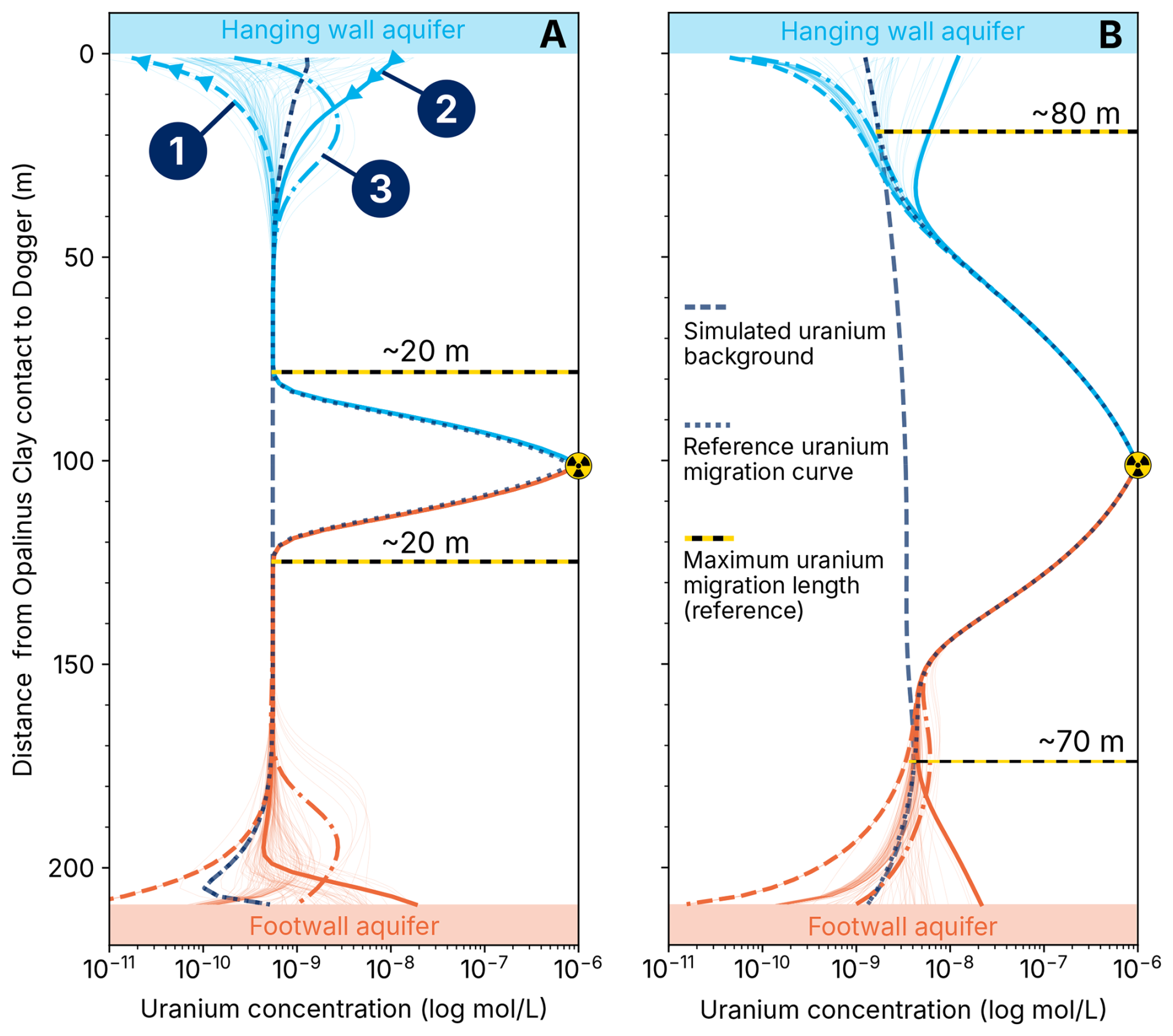
Figure 5Simulated uranium concentration profiles depending on varying boundary conditions in the hanging wall (blue lines) and footwall (orange lines) aquifers are contrasted for two different initial conditions: a constant profile of pore water chemistry (A) and a pronounced gradient in the composition (B). Each line corresponds to a simulation with one of 212 available groundwater analyses from northern Switzerland (Fig. 3) as boundary condition. Results are compared to modelled uranium background concentrations (dark blue dashed line) and the reference simulation by Hennig and Kühn (2021a), which is shown in the dark blue dotted line. Yellow-black dashed horizontal lines indicate the maximum migration distance in the respective scenario. Representative profiles depicting the main effects caused by boundary conditions are highlighted in bold and referred to in the text.
Variations of groundwater chemistry in surrounding aquifers of the CRZ influence uranium concentrations close to the model boundaries. Three distinct observations are identified from the more than 200 simulations and concentration profiles for each of the two scenarios with variable boundary conditions. Uranium concentrations (1a) decrease towards the model boundary below concentrations quantified in the reference case, (1b) increase at the model outlet above the reference, and (2) are up to an order of magnitude higher than natural background at distances of at most 60 m from the contacts between the CRZ and the adjacent units.
Uranium migration distances from the simulated repository in the model centre towards the outlets are not significantly affected by boundary conditions varying in groundwater chemistry over one million years. The majority of simulated concentration curves match the reference case with approximately 80 and 70 m migration distances from the centre of the CRZ to the overlying Dogger and underlying Liassic Gryphaea limestones, respectively (Hennig and Kühn, 2021a). In a few simulations of scenario B, migration distances decrease by about 10 m with the background level of uranium increasing overall in these cases (solid, bold blue line in Fig. 5B). The effects of perturbations in groundwater chemistry on uranium concentrations in the model are limited to a maximum 60 m wide zone at the model boundaries.
Gradients in profiles of pore water composition lead to larger uranium migration distances. From the centre of the CRZ towards the bounding aquifers, the pore water composition (ion concentrations, pH, redox potential) is initially constant in scenario A, whereas it changes in scenario B. Hennig and Kühn (2021a) attributed the larger migration distance in a setting with an inherent gradient in the pore water chemistry to changes in the sorption capacity along it. This effect is primarily controlled by the pH, which affects uranium speciation and is governed by the availability of calcium, magnesium and carbonate ions via the calcite-carbonate equilibrium (Hennig and Kühn, 2021a). Carbonate concentrations increase towards the aquifers at Mont Terri (Fig. 6), and with that the formation of more ternary uranyl complexes. Hence, the sorption capacity decreases and uranium migration distances increase (scenario B) compared to constant conditions (scenario A).
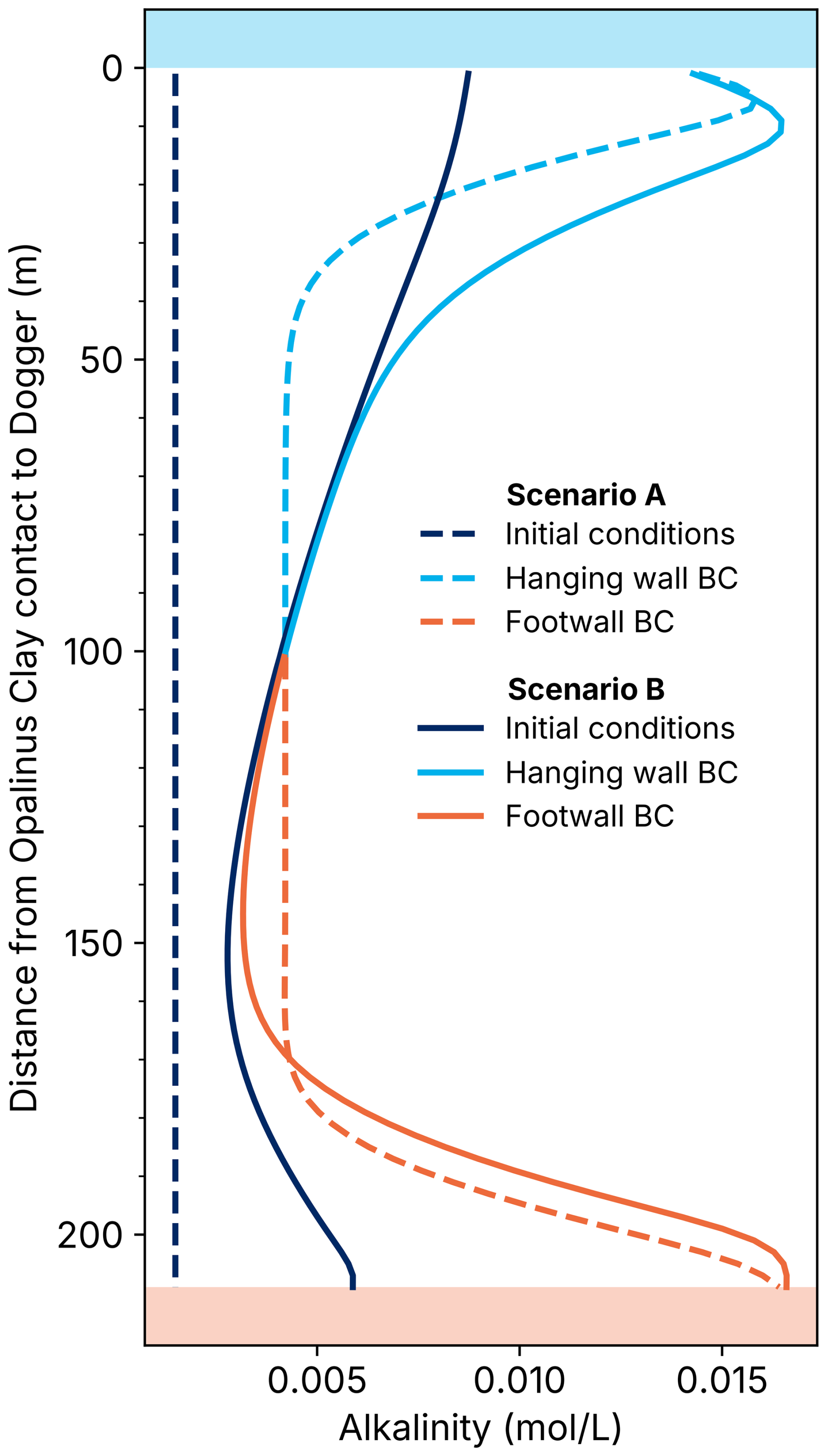
Figure 6Scenario B is initially characterised by increasing alkalinity towards the adjacent aquifers of the CRZ (darker blue, solid line), while the alkalinity is constant in scenario A (darker blue, dashed line). Alkalinity profiles after one million years for both scenarios are shown for simulations with boundary conditions (BC) that are representative of the boundary effect 2 (see Fig. 5) in the hanging wall (lighter blue) and footwall aquifer (orange).
Variations in natural uranium concentrations in aquifers do not significantly influence the migration distance from the CRZ. Uranium diffuses into or out of the model, when natural concentrations in adjacent aquifers exceed (1a, Fig. 5) or fall below the background levels in the CRZ (1b, Fig. 5), respectively (summarised to boundary effect 1). This bidirectional diffusion effect propagates up to 40 m into the low permeable section from the upper and lower boundary in both scenarios. The effective range therefore depends primarily on the concentration gradient of natural uranium between aquifers and CRZ and not on the initial profile of pore water chemistry. However, the latter and the thickness of the CRZ determine whether this boundary effect on natural uranium interferes with uranium originating from the repository in the model centre. This only occurs in scenario B, when the inherent gradient in pore water chemistry increases the migration distance and at the same time comparatively high natural uranium concentrations of about 10−8 mol L−1 are present in the aquifers (bold, solid blue line, Fig. 5B). The resulting increase in natural uranium at the boundaries of the CRZ causes a decrease in the concentration gradient from the model centre outwards. Hence, diffusion-driven mass transport, and thus uranium migration distance, is reduced by approximately 10 m compared to the reference case. This represents a positive effect for potential disposal sites, accordingly. In contrast, the shorter migration distance (∼ 20 m) in scenario A combined with a sufficient thickness of the CRZ impedes an overlap with the signal of boundary effect 1. To summarise, varying uranium concentrations in the aquifers influence the natural uranium content at the boundaries of the CRZ.
Alkalinity differences between the CRZ and surrounding aquifers affect natural uranium concentrations at the model boundaries (boundary effect 2). Local uranium concentration peaks near the margins of the CRZ (Fig. 5A and B) are associated with groundwaters that exhibit higher alkalinities than the reference case, the present-day groundwater composition at Mont Terri (Fig. 6). In these cases, bicarbonate diffuses into the low permeable rock sequence, which shifts the calcite-carbonate equilibrium, increases the pH, and affects uranium speciation (Hennig and Kühn, 2021a) close to the model boundaries. As a result of increased alkalinity, the sorption capacity decreases, so that the dissolved natural uranium concentration in the pore water increases up to 60 m into the CRZ with no or minimal effect on migration from the model centre, analogous to boundary effect 1.
The minor effects of variable boundary conditions on uranium migration demonstrate a substantial buffering capacity of the Opalinus Clay and its low permeable confining units against these geochemical perturbations. This has already been reported in Nagra (2002) and by Mazurek et al. (2023b) for surficial Opalinus Clay. The two systematic cause-effect relationships distilled from the large variability of the analysed data (boundary effects 1 and 2) mainly affect the natural uranium concentrations in a maximum 60 m wide zone at the boundaries of the CRZ within one million years. Furthermore, the thickness of the CRZ determines whether the effects of geochemical disturbances can overlap with uranium migration from the centre. The thickness required to exclude this interference is not fixed, but depends on the profile of pore water chemistry and must be larger in the case of a gradient compared to constant conditions. The high buffering capacity of the Opalinus Clay and its confining low permeable units in a sufficiently thick CRZ ensure that geochemical disturbances at the boundaries have no significant effect on uranium migration from a radioactive waste repository in the centre for the investigated cases.
Present-day pore water profiles are essential for safety assessments in the context of radioactive waste disposal in argillaceous formations. Firstly, they represent initial conditions for simulating radionuclide migration, i.e. for making prognoses about their transport behaviour after disposal of the radioactive waste. These simulations provide the basis for radiological consequence analysis, which is performed to determine whether a site fulfils the dose safety criterion. The characteristics of the pore water chemistry in the CRZ are a decisive factor for the quantification of radionuclide migration as shown for uranium. Secondly, depth profiles of natural tracers such as chloride and the stable isotopes of water provide insights into solute transport processes over the past millions of years (Mazurek et al., 2011; Mazurek and de Haller, 2017; Wersin et al., 2023). These profiles can be seen as the geochemical memory of the CRZ, from which safety-relevant conclusions can be drawn about the dominant transport process, the influence of hydraulically active faults and advective flow, and the long-term barrier effect of the CRZ (Mazurek et al., 2009). The application of pore water chemistry profiles in simulating radionuclide migration and interpreting past solute transport processes makes them indispensable for site comparison and demonstrating long-term safety of disposal sites.
Indirect methods for determining pore water chemistry profiles are required when measured data are not available and cannot be acquired. Procedures for pore water sampling and analyses improved in the last decades, but involve considerable technical, time and financial resources (Waber and Rufer, 2017; Wersin et al., 2022; Mazurek et al., 2025). Therefore, deriving high-resolution and high-quality profiles of pore water chemistry, such as those available for Mont Terri (Pearson et al., 2003; Wersin et al., 2022), the Swiss siting regions (Mazurek et al., 2023a; Wersin et al., 2023; Gimmi et al., 2024), or selected boreholes in other European countries (Mazurek et al., 2009, 2011), will in most cases be limited to later stages of national site selection processes focussing on a few specific sites due to practical and economic reasons. This detailed information is lacking in earlier stages, when large areas still need to be assessed, which is currently the case in Germany (BGE, 2020). The challenge is to decide on the suitability of sub-areas without having a comprehensive data basis or any information related to pore water chemistry at all. This lack of pore water data in early phases must be reduced, given its high informative value and importance for safety assessments. Therefore, future studies should examine the feasibility of estimating pore water chemistry profiles, particularly those of natural tracers. Methods should be developed to obtain information about pore water chemistry, and thus about initial conditions for simulating radionuclide migration, for example by using more readily available and less expensive indirect approaches and indicators (Bonitz et al., 2025), or by modelling based on conceptual considerations, paleohydrogeological insights and available data (Hennig and Kühn, 2021a).
Our findings are relevant for the site selection process in Germany. The Opalinus Clay and its bounding aquifers also occur within German territory (Fig. 3). Ionic strengths and water compositions of the groundwater samples investigated in this study cover a range similar to that of corresponding regional groundwater-bearing formations in southern Germany (Stober et al., 2014). The discussed effects of changes in groundwater chemistry on the uranium concentration in the CRZ are already based on data from a broad regional scale. Hence, the general findings are also relevant for the sub-area with Opalinus Clay in southern Germany (BGE, 2020), although this was not particularly covered in the analysed groundwater data.
The initial pore water composition in the containment providing rock zone (CRZ) is more decisive for uranium migration than variations in groundwater chemistry of the bounding aquifers, as shown for the example of the Opalinus Clay. Gradients in pore water chemistry can enhance uranium migration by several decametres. Constant pore water chemistry profiles are favourable from a safety perspective with regard to the tested case for uranium migration.
Variations in the groundwater chemistry of bounding aquifers in the investigated system do not substantially affect the migration of uranium, even if the chemical regime changes significantly. This indicates a considerable buffering capacity of the system. Perturbations in adjacent aquifers are limited to the outer 60 m of the CRZ in one million years. The probability of interference from external disturbances in bounding aquifers with uranium migration from a repository in the centre of the CRZ decreases as the thickness of the CRZ increases.
Changes in the groundwater composition of surrounding aquifers affect natural uranium concentrations at the CRZ boundaries in two distinct ways. Diffusion of uranium into or out of the CRZ occurs, when natural concentrations in adjacent aquifers are higher or lower than the background levels within the CRZ (boundary effect 1), respectively. If the alkalinity in aquifers increases, bicarbonate diffuses into the CRZ, leading to changes in the uranium speciation and hence sorption capacity (boundary effect 2). The first effect is related to changes in the uranium concentration due to changes of the natural uranium content in groundwater and the second is related to its alkalinity.
Deriving initial conditions of the pore water chemistry is of major importance for simulations of radionuclide migration. To define these at earlier stages of a site selection process with limited amounts of data available represents a challenge for modelling and decision-making. In future studies, we will therefore investigate how present-day pore water chemistry profiles, and thus initial model conditions, can be deduced conceptually without direct measurements of the pore water composition in order to support the search for final disposal sites for highly radioactive waste with reactive transport models in earlier phases.
All applied software codes are referenced within the manuscript and open access. The input scripts required to reproduce the presented simulations can be directly obtained by contacting the corresponding author.
All input data is referenced within the manuscript (Sect. 2 and references therein).
Conceptualization of the manuscript was done by both authors. The software maintenance, investigation as well as original draft writing was conducted by TS.
The contact author has declared that neither of the authors has any competing interests.
Publisher's note: Copernicus Publications remains neutral with regard to jurisdictional claims made in the text, published maps, institutional affiliations, or any other geographical representation in this paper. The authors bear the ultimate responsibility for providing appropriate place names. Views expressed in the text are those of the authors and do not necessarily reflect the views of the publisher.
This article is part of the special issue “European Geosciences Union General Assembly 2025, EGU Division Energy, Resources & Environment (ERE)”. It is a result of the EGU General Assembly 2025, Vienna, Austria & Online, 27 April–2 May 2025.
The authors would like to thank Michael Kühn for the fruitful discussions and comments that have benefited this work. Furthermore, the authors would like to thank the reviewers Alwina Hoving and Johannes Miocic for their time and annotations that helped improving the manuscript.
The article processing charges for this open-access publication were covered by the GFZ Helmholtz Centre for Geosciences.
This paper was edited by Johannes Miocic and reviewed by Alwina Hoving and one anonymous referee.
Altmann, S.: “Geo”chemical Research: A Key Building Block for Nuclear Waste Disposal Safety Cases, Journal of Contaminant Hydrology, 102, 174–179, https://doi.org/10.1016/j.jconhyd.2008.09.012, 2008. a
Altmann, S., Tournassat, C., Goutelard, F., Parneix, J. C., Gimmi, T., and Maes, N.: Diffusion-Driven Transport in Clayrock Formations, Applied Geochemistry, 27, 463–478, https://doi.org/10.1016/j.apgeochem.2011.09.015, 2012. a
BGE: Sub-Areas Interim Report Pursuant to Section 13 StandAG, Interim Report SG01101/16-1/2-2021#1, Bundesgesellschaft für Endlagerung mbH, https://www.bge.de/de/endlagersuche/zwischenbericht-teilgebiete/ (last access: 16 June 2025), 2020. a, b, c, d
Bonitz, M., Hennig, T., Schleicher, A. M., Jaeggi, D., Stammeier, J. A., Ostertag-Henning, C., and Kühn, M.: Bulk Rock Geochemical and Mineralogical Characterisation of Clay-Rich Sediments from Drill Core Analysis of the Staffelegg Formation, Applied Geochemistry, 186, 106389, https://doi.org/10.1016/j.apgeochem.2025.106389, 2025. a
Bossart, P. and Thury, M.: Characteristics of the Opalinus Clay at Mont Terri, Reports of the Swiss Geological Survey, no. 3, https://www.mont-terri.ch/en (last access: 20 June 2025), 2008. a, b
Bradbury, M. H. and Baeyens, B.: Porewater Chemistry in Compacted Re-Saturated MX-80 Bentonite: Physico-Chemical Characterisation and Geochemical Modelling, Tech. rep., PSI, Villingen, Switzerland, ISSN 1015-2636, 2002. a
Bradbury, M. H. and Baeyens, B.: Experimental and Modelling Investigations on Na-illite: Acid-base Behaviour and the Sorption of Strontium, Nickel, Europium and Uranyl, Nagra Technical Report, NTB 04-02, ISSN 1015-2636, 2005a. a
Bradbury, M. H. and Baeyens, B.: Modelling the Sorption of Mn(II), Co(II), Ni(II), Zn(II), Cd(II), Eu(III), Am(III), Sn(IV), Th(IV), Np(V) and U(VI) on Montmorillonite: Linear Free Energy Relationships and Estimates of Surface Binding Constants for Some Selected Heavy Metals and Actinide, Geochimica et Cosmochimica Acta, 69, 875–892, https://doi.org/10.1016/j.gca.2004.07.020, 2005b. a, b
Bradbury, M. H. and Baeyens, B.: Sorption Modelling on Illite Part I: Titration Measurements and the Sorption of Ni, Co, Eu and Sn, Geochimica et Cosmochimica Acta, 73, 990–1003, https://doi.org/10.1016/j.gca.2008.11.017, 2009. a, b
Bradbury, M. H. and Baeyens, B.: The Development of a Thermodynamic Sorption Data Base for Illite and the Application to Argillaceous Rocks, Tech. rep., ISSN 1015-2636, 2017. a
Charlton, S. R. and Parkhurst, D. L.: Modules Based on the Geochemical Model PHREEQC for Use in Scripting and Programming Languages, Computers & Geosciences, 37, 1653–1663, https://doi.org/10.1016/j.cageo.2011.02.005, 2011. a
Freivogel, M. and Huggenberger, P.: Modellierung Bilanzierter Profile Im Gebiet Mont Terri – La Croix (Kanton Jura), in: Reports of the FOWG, Geology Series, No 4.: Mont Terri Project – Geology, Paleohydrology and Stress Field of the Mont Terri Region, 7–44, ISBN 3-906723-58-5, 2003. a
Geckeis, H., Lützenkirchen, J., Polly, R., Rabung, T., and Schmidt, M.: Mineral–Water Interface Reactions of Actinides, Chemical Reviews, 113, 1016–1062, https://doi.org/10.1021/cr300370h, 2013. a
Gimmi, T., Aschwanden, L., Waber, H. N., Gaucher, E. C., Ma, J., and Traber, D.: Profiles of δ18O and δ2H in Porewater of a Mesozoic Rock Sequence: Regional Variability and Relation to Large-Scale Transport Regimes, Applied Geochemistry, 160, https://doi.org/10.1016/j.apgeochem.2023.105846, 2024. a, b
Hennig, T. and Kühn, M.: Potential Uranium Migration within the Geochemical Gradient of the Opalinus Clay System at the Mont Terri, Minerals, 11, 1–22, https://doi.org/10.3390/min11101087, 2021a. a, b, c, d, e, f, g, h, i, j, k, l, m, n, o, p, q, r
Hennig, T. and Kühn, M.: Surrogate Model for Multi-Component Diffusion of Uranium through Opalinus Clay on the Host Rock Scale, Applied Sciences (Switzerland), 11, 1–21, https://doi.org/10.3390/app11020786, 2021b. a, b
Hennig, T. and Kühn, M.: Uranium migration lengths in Opalinus Clay depend on geochemical gradients, radionuclide source term concentration and pore water composition, Advances in Geosciences, 62, 21–30, https://doi.org/10.5194/adgeo-62-21-2023, 2023. a, b
Hennig, T., Stockmann, M., and Kühn, M.: Simulation of Diffusive Uranium Transport and Sorption Processes in the Opalinus Clay, Applied Geochemistry, 123, https://doi.org/10.1016/j.apgeochem.2020.104777, 2020. a, b, c, d
Horita, J., Zimmermann, H., and Holland, H. D.: Chemical Evolution of Seawater during the Phanerozoic: Implications from the Record of Marine Evaporites, Geochimica et Cosmochimica Acta, 66, 3733–3756, https://doi.org/10.1016/S0016-7037(01)00884-5, 2002. a
Hummel, W. and Thoenen, T.: The PSI Chemical Thermodynamic Database 2020, Technical Report 21-03, Nagra, ISSN 1015-2636, 2023. a, b
Joseph, C., Schmeide, K., Sachs, S., Brendler, V., Geipel, G., and Bernhard, G.: Sorption of Uranium(VI) onto Opalinus Clay in the Absence and Presence of Humic Acid in Opalinus Clay Pore Water, Chemical Geology, 284, 240–250, https://doi.org/10.1016/j.chemgeo.2011.03.001, 2011. a
Joseph, C., Stockmann, M., Schmeide, K., Sachs, S., Brendler, V., and Bernhard, G.: Sorption of U(VI) onto Opalinus Clay: Effects of pH and Humic Acid, Applied Geochemistry, 36, 104–117, https://doi.org/10.1016/j.apgeochem.2013.06.016, 2013a. a, b
Joseph, C., Van Loon, L. R., Jakob, A., Steudtner, R., Schmeide, K., Sachs, S., and Bernhard, G.: Diffusion of U(VI) in Opalinus Clay: Influence of Temperature and Humic Acid, Geochimica et Cosmochimica Acta, 109, 74–89, https://doi.org/10.1016/j.gca.2013.01.027, 2013b. a, b
Keesmann, S., Noseck, U., Buhmann, D., Fein, E., and Schneider, A.: Modellrechnungen Zur Langzeitsicherheit von Endlagern in Salz- Und Granitformationen, Tech. Rep. GRS-206, Gesellschaft für Anlagen- und Reaktorsicherheit (GRS) mbH, ISBN 3931995739, 2005. a
Koroleva, M., Alt-Epping, P., and Mazurek, M.: Large-Scale Tracer Profiles in a Deep Claystone Formation (Opalinus Clay at Mont Russelin, Switzerland): Implications for Solute Transport Processes and Transport Properties of the Rock, Chemical Geology, 280, 284–296, https://doi.org/10.1016/j.chemgeo.2010.11.016, 2011. a
Marques Fernandes, M., Vér, N., and Baeyens, B.: Predicting the Uptake of Cs, Co, Ni, Eu, Th and U on Argillaceous Rocks Using Sorption Models for Illite, Applied Geochemistry, 59, 189–199, https://doi.org/10.1016/j.apgeochem.2015.05.006, 2015. a
Mazurek, M. and de Haller, A.: Pore-Water Evolution and Solute-Transport Mechanisms in Opalinus Clay at Mont Terri and Mont Russelin (Canton Jura, Switzerland), Swiss Journal of Geosciences, 110, 129–149, https://doi.org/10.1007/s00015-016-0249-9, 2017. a, b
Mazurek, M., Alt-Epping, P., Bath, A., Gimmi, T., and Waber, H. N.: Natural Tracer Profiles Across Argillaceous Formations: The CLAYTRAC Project, Tech. rep., Nuclear Energy Agency, ISBN 9789264060470, 2009. a, b, c
Mazurek, M., Alt-Epping, P., Bath, A., Gimmi, T., Niklaus Waber, H., Buschaert, S., Cannière, P. D., Craen, M. D., Gautschi, A., Savoye, S., Vinsot, A., Wemaere, I., and Wouters, L.: Natural Tracer Profiles across Argillaceous Formations, Applied Geochemistry, 26, 1035–1064, https://doi.org/10.1016/j.apgeochem.2011.03.124, 2011. a, b, c, d, e, f, g, h, i, j
Mazurek, M., Gimmi, T., Zwahlen, C., Aschwanden, L., Gaucher, E. C., Kiczka, M., Rufer, D., Wersin, P., Fernandes, M. M., Glaus, M. A., Van Loon, L. R., Traber, D., Schnellmann, M., and Vietor, T.: Swiss Deep Drilling Campaign 2019–2022: Geological Overview and Rock Properties with Focus on Porosity and Pore-Space Architecture, Applied Geochemistry, 159, 105839, https://doi.org/10.1016/j.apgeochem.2023.105839, 2023a. a, b
Mazurek, M., Wersin, P., Hadi, J., Grenèche, J.-M., Prinpreecha, N., and Traber, D.: Geochemistry and Palaeo-Hydrogeology of the Weathered Zone in the Opalinus Clay, Applied Clay Science, 232, 106793, https://doi.org/10.1016/j.clay.2022.106793, 2023b. a, b
Mazurek, M., Wersin, P., Eichinger, F., Bath, A., Al, T., Clark, I. D., Kennell-Morrison, L., Kampman, N., and Traber, D.: Techniques for Porewater Extraction from Clayrocks, Applied Clay Science, 273, 107855, https://doi.org/10.1016/j.clay.2025.107855, 2025. a
Müller, M.: PhreeqPy – Python Tools for PHREEQC, https://www.phreeqpy.com (last access: 9 February 2026), 2025. a
Müller, M., Parkhurst, D. L., and Charlton, S. R.: Programming PHREEQC Calculations with C++ and Python – A Comparative Study, in: Proceedings for MODFLOW and More 2011: Integrated Hydrologic Modeling, Golden, Colorado, 632–636, https://www.phreeqpy.com/Mueller_etal_MODFLOWandMORE2011_Proceedings.pdf (last access: 9 February 2026), 2011. a
Nagra: Project Opalinus Clay – Synthesis of the geological research results, Technical Report 02-03, Nagra, Wettingen, Switzerland, ISSN 1015-2636, 2002. a, b, c
Parkhurst, D. L. and Appelo, C. A. J.: Description of Input and Examples for PHREEQC Version 3 – A Computer Program for Speciation, Batch-Reaction, One-Dimensional Transport, and Inverse Geochemical Calculations, ISBN 0092-332X, 2013. a, b
Pearson, F. J., Arcos, D., Bath, A., Boisson, J.-Y., Fernández, A. M., Gäbler, H. E., Gaucher, E. C., Gautschi, A., Griffault, L., Hernán, P., and Waber, H. N.: Mont Terri Project – Geochemistry of Water in the Opalinus Clay Formation at the Mont Terri Rock Laboratory, Tech. Rep. 5, Federal Office for Water and Geology, FOWG, Bern, Switzerland, ISBN 3-906723-59-3, 2003. a, b, c, d, e
Pearson, F. J., Tournassat, C., and Gaucher, E. C.: Biogeochemical Processes in a Clay Formation in Situ Experiment: Part E – Equilibrium Controls on Chemistry of Pore Water from the Opalinus Clay, Mont Terri Underground Research Laboratory, Switzerland, Applied Geochemistry, 26, 990–1008, https://doi.org/10.1016/j.apgeochem.2011.03.008, 2011. a
Philipp, T., Shams Aldin Azzam, S., Rossberg, A., Huittinen, N., Schmeide, K., and Stumpf, T.: U(VI) Sorption on Ca-bentonite at (Hyper)Alkaline Conditions – Spectroscopic Investigations of Retention Mechanisms, Science of The Total Environment, 676, 469–481, https://doi.org/10.1016/j.scitotenv.2019.04.274, 2019. a
Schmassmann, H.: Hydrochemische Synthese Nordschweiz: Tertiär- und Malm-Aquifere, Technical Report 88-07, Nagra, 1990. a
Schmassmann, H., Kullin, M., and Schneemann, K.: Hydrochemische Synthese Nordschweiz: Buntsandstein-, Perm- und Kristallin-Aquifere, Technical Report 91-30, Nagra, 1992. a
Steinthorsdottir, M., Jeram, A. J., and McElwain, J. C.: Extremely Elevated CO2 Concentrations at the Triassic/Jurassic Boundary, Palaeogeography, Palaeoclimatology, Palaeoecology, 308, 418–432, https://doi.org/10.1016/j.palaeo.2011.05.050, 2011. a
Stober, I., Wolfgramm, M., and Birner, J.: Hydrochemie der Tiefenwässer in Deutschland, Journal for Geological Sciences, 41/42, 339–380, 2014. a
Stockmann, M., Schikora, J., Becker, D. A., Flügge, J., Noseck, U., and Brendler, V.: Smart Kd-values, Their Uncertainties and Sensitivities – Applying a New Approach for Realistic Distribution Coefficients in Geochemical Modeling of Complex Systems, Chemosphere, 187, 277–285, https://doi.org/10.1016/j.chemosphere.2017.08.115, 2017. a
Waber, H. N. and Rufer, D.: Pore Water Geochemistry, Method Comparison and Opalinus Clay – Passwang Formation Interface Study at the Mont Terri URL, Tech. Rep. NWMO-TR-2017-10, Nuclear Waste Management Organization, 2017. a
Wersin, P., Mazurek, M., Mäder, U. K., Gimmi, T., Rufer, D., Lerouge, C., and Traber, D.: Constraining Pore Water Chemistry in a 250 m Thick Argillaceous Rock Sequence, Chemical Geology, 434, 43–61, https://doi.org/10.1016/j.chemgeo.2016.04.006, 2016. a, b
Wersin, P., Gimmi, T., Mazurek, M., Alt-Epping, P., Pękala, M., and Traber, D.: Multicomponent Diffusion in a 280 m Thick Argillaceous Rock Sequence, Applied Geochemistry, 95, 110–123, https://doi.org/10.1016/j.apgeochem.2018.05.013, 2018. a
Wersin, P., Mazurek, M., and Gimmi, T.: Pore Water Chemistry of Opalinus Clay Revisited: Findings from 25 Years of Data Collection at the Mont Terri Rock Laboratory, Applied Geochemistry, 138, 105234, https://doi.org/10.1016/j.apgeochem.2022.105234, 2022. a, b, c
Wersin, P., Gimmi, T., Ma, J., Mazurek, M., Zwahlen, C., Aschwanden, L., Gaucher, E., and Traber, D.: Pore Water Profiles of Cl and Br in Boreholes Penetrating the Mesozoic Sequence in Northern Switzerland, Applied Geochemistry, 159, 105845, https://doi.org/10.1016/j.apgeochem.2023.105845, 2023. a, b, c, d, e, f, g, h
Yang, J., Liu, H., Tang, Z., Peeters, L., and Ye, M.: Visualization of Aqueous Geochemical Data Using Python and WQChartPy, Groundwater, 60, 555–564, https://doi.org/10.1111/gwat.13185, 2022. a